
Almost three-quarters of public Bitcoin Lightning nodes recognized as uncovered in August remained on affected software program traces in October.
An Oct. 21 examine discovered that 71% of a bunch of 550 public LND nodes flagged throughout an Aug. 11 safety disclosure have been nonetheless working on affected software program launch traces as of Oct. 13.
Solely about 10% had upgraded throughout that interval, whereas 108 nodes have been not categorised as stay. The findings counsel that safety fixes are reaching some Lightning operators effectively after their launch dates.
The delays are notably placing as a result of patches for six vulnerabilities coated by the August disclosures had been out there since LND model 0.19.0, launched 446 days earlier than the general public warning.
LND is without doubt one of the software program implementations used to function nodes on Bitcoin’s Lightning Community, which processes funds exterior the blockchain’s major transaction layer.
Lightning upgrades observe platform releases relatively than safety warnings
Analysis by Saurabh Kumar of Bitcoin Knowledge Labs discovered that the community’s largest software program improve waves carefully adopted releases from Umbrel, a platform that packages Bitcoin node software program.
The three largest waves concerned between 262 and 385 nodes every, with at the least 87% of taking part nodes broadcasting up to date software program options inside 48 hours of an Umbrel launch.
Nevertheless, Umbrel distributed these variations between 19 and 41 days after the corresponding LND releases, introducing one other potential delay between builders making fixes out there and operators receiving them via their most popular platforms.
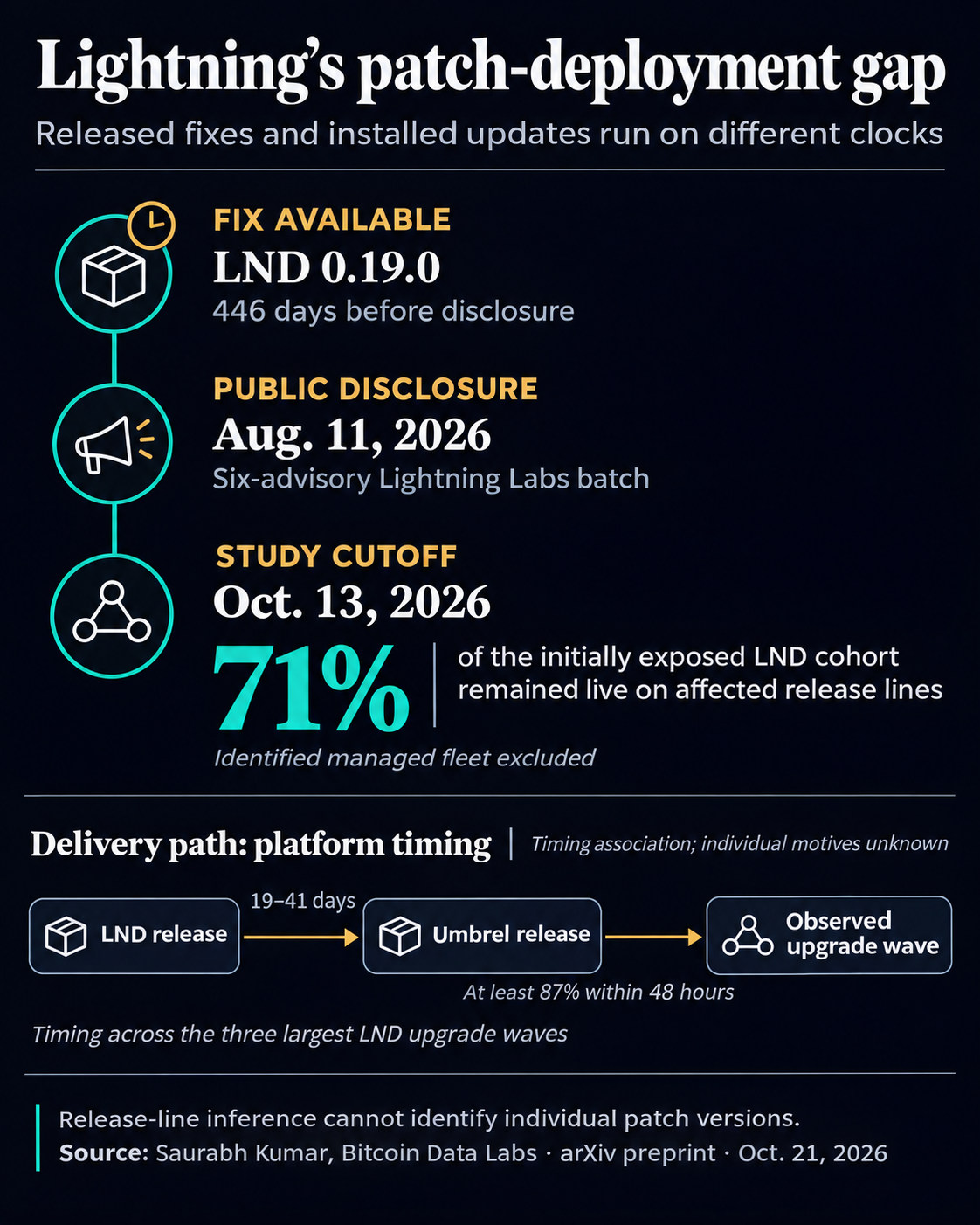
The affiliation means that software program distribution channels can considerably affect how shortly Bitcoin’s fee infrastructure adopts safety enhancements. The examine couldn’t determine which platforms particular person nodes used, leaving the exact position of computerized updates unresolved.
Public safety warnings appeared much less efficient at altering operator conduct.
Throughout 9 LND vulnerability disclosures, the researcher discovered no statistically detectable acceleration in nodes shifting away from affected software program traces. The findings don’t rule out smaller responses, however they present that disclosures weren’t adopted by clear, widespread improve surges.
The delays additionally lengthen past safety incidents. Nodes working older software program when LND variations 0.19 via 0.21 turned out there took an estimated median of 88 days emigrate to the newer launch traces.
Nonetheless, the potential publicity is erratically distributed throughout Lightning’s fee infrastructure.
On the August disclosure, affected launch traces accounted for 14.9% of stay LND nodes however solely 6.4% of their channel capability, excluding an recognized managed fleet. That disparity means that affected nodes managed a comparatively smaller share of fee liquidity.
The researcher analyzed 814 every day snapshots of Lightning’s public community graph, utilizing marketed software program options to deduce launch traces. The strategy can not determine actual patch variations, and nodes that improve with out broadcasting new bulletins could proceed to look uncovered. Precise exploitability additionally is dependent upon the vulnerability and the node’s configuration.
Kumar revealed the examine’s code and combination information alongside the preprint, permitting additional scrutiny of the findings. The analysis leaves node software program builders and platform distributors going through an unresolved operational query: learn how to scale back the weeks or months between releasing safety fixes and getting them put in throughout Lightning’s public community.