Once you promote a share in a staking Ethereum ETF, the customer pays for it even when a few of the ETH backing the fund remains to be dedicated to validating transactions on the community.
You may depart the funding whereas these cash maintain incomes rewards, as a result of promoting a share transfers your curiosity to a different investor with out requiring the fund to withdraw the ETH.
Giant establishments, then again, have one other manner out: they will return shares on to the fund in alternate for money or belongings, relying on the product’s phrases.
That course of helps maintain share costs near the worth of the holdings, but it surely turns into a lot more durable to handle when a fund must ship cash that Ethereum hasn’t but launched from staking.
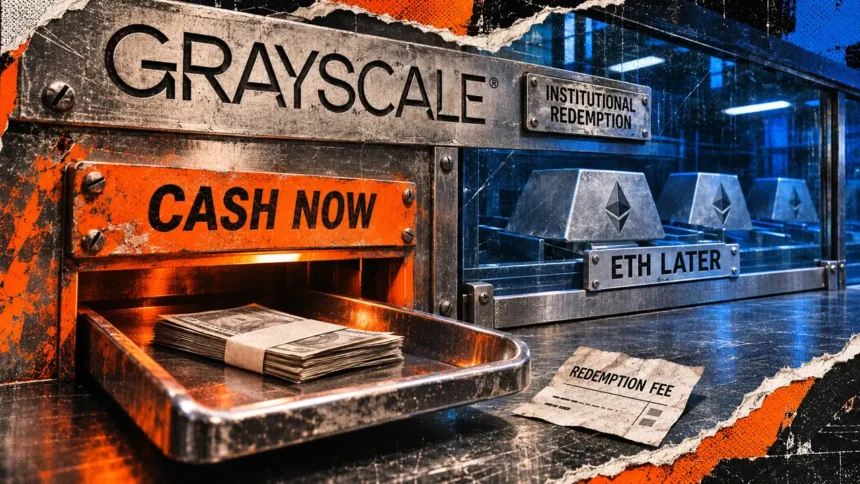
If an surprising scarcity exhausts the fund’s unstaked reserve, an organization providing staking Ethereum ETFs like Grayscale can organize for a collaborating buying and selling firm to produce {dollars} for a money redemption and obtain the ETH later, paying the redeeming establishment whereas the cash work their manner by way of withdrawal.
The corporate earns an upfront payment and bears the distinction between the ETH’s value on the commerce date and its value at supply, although it could hedge that publicity.
The phrases seem in a filed liquidity-provider settlement that turns a network-imposed wait into an expense the events can conform to finance.
For buyers evaluating Ethereum ETFs, the association affords a option to look past staking yield alone: funds holding the identical asset can depend on completely different establishments, with completely different obligations, to maintain redemptions transferring.
Who pays when an Ethereum ETF has to attend for ETH
Licensed contributors, normally a broker-dealer, redeem by returning a big block of shares referred to as a basket.
In an bizarre Grayscale money redemption, a liquidity supplier provides the {dollars} and receives ETH from the fund, which usually makes use of cash it has stored out of staking. That unstaked reserve permits buyers to depart with out the fund having to provoke a validator exit for each redemption.
Preserving extra ETH accessible reduces the proportion incomes staking rewards, so the sponsor has to stability revenue in opposition to the belongings it could want to maneuver promptly.
Even when it requests a withdrawal, the fund should anticipate Ethereum’s exit and withdrawal procedures earlier than the cash develop into transferable.
Grayscale’s April disclosure for its flagship Ethereum ETF (ETHE) restricts delayed supply to an unexpected, atypical liquidity occasion that exhausts the unstaked reserve, and solely till that reserve is replenished.
As soon as a collaborating firm accepts such an order, it provides the money whereas the fund owes the designated ETH on the primary enterprise day these specific cash develop into transferable, even when different ETH turns into accessible sooner.
The redeeming dealer pays the payment, which compensates the buying and selling firm for the anticipated wait and stays fastened as soon as agreed.
The Mini ETF’s Nov. 19 submitting describes the identical cash-first sequence and specifies that neither aspect receives an adjustment if the precise supply date differs from the estimate. An extended wait can tie up the corporate’s cash and hedges for longer with out incomes it further compensation underneath that order.
The dealer pays a hard and fast payment; the buying and selling agency provides money now and accepts supply of designated ether later.
ETHE’s April disclosure restricts use to an unexpected, atypical occasion that exhausts the unstaked reserve, till replenishment. Solely collaborating corporations can settle for orders. The reviewed filings don’t determine a accomplished order or mixture dedicated capability.
The corporate can account for that chance in its preliminary quote, and the price of accepting a brand new order can differ from the cost on an current one.
Nevertheless, just some suppliers have agreed to delayed supply, and Grayscale’s disclosure affords no assurance that these preparations will provide sufficient liquidity.
An in a single day mortgage covers a distinct delay
BlackRock and Morgan Stanley disclose financing that lets a fund transact whereas ETH strikes from custody to a buying and selling account.
In line with BlackRock’s ETHB prospectus, motion out of custody can take as much as 24 hours or longer. The corporate stated Coinbase Credit score provides belongings or money for trades within the meantime.
The fund typically has to repay these commerce credit by 6 p.m. New York time on the following enterprise day, with availability depending on the lender having the mandatory assets and the settlement’s different circumstances.
Morgan Stanley’s MSSE prospectus units a common reimbursement deadline of 6 p.m. on the following day, together with weekends, and likewise contemplates separate liquidity preparations.
A validator withdrawal can outlast these routine credit, so an in a single day facility alone does not set up {that a} fund can finance an prolonged staking exit.
Share of every fund’s complete Ethereum holdings exterior staking on Sept. 30. ETHE is calculated from staked and complete ETH truthful values and rounded to 1 decimal, whereas the opposite shares equal 100% minus the reported staked share.
 yourcryptonewstoday
Some unstaked cash could already be wanted for different orders or distributions, and a single day’s stability can differ significantly from a fund’s standard combine. For instance, TETH ended September with 50.9% staked, whereas its each day staked share averaged 76.05% in the course of the quarter.
The bigger reserve at quarter-end does not inform us what was accessible all through these three months or how a lot exterior financing the fund may acquire.
BlackRock’s redemption provisions for its Ethereum ETF describe the fund’s capability to delay settlement or use completely different redemption procedures in specified circumstances.
The payment can enter the worth you obtain
Suppose an establishment can purchase a basket’s value of shares for $998,000 and redeem it for $1 million earlier than prices. It has $2,000 to cowl execution and financing, together with safety in opposition to value actions.
If these bills complete $1,000, the commerce leaves $1,000 earlier than different prices; if an anticipated delay lifts them to $3,000, shopping for on the similar value would lose cash.
The establishment may then bid much less for the shares or go on the commerce, relying on the options accessible. Shareholders promoting into that decrease bid would obtain much less, although the licensed participant pays the contractual redemption payment.
Competitors between buying and selling firms can restrict how a lot of that price reaches buyers, however assigning a payment to the dealer does not cease firms from incorporating it into their costs.
Nevertheless, this can be a hypothetical calculation, not proof that staking has prompted a selected Ethereum ETF low cost.
Spreads and reductions can transfer for different causes, and measuring a shareholder’s price would require contemporaneous quotes and a comparable web asset worth. The instance reveals how redemption phrases can have an effect on a vendor earlier than any underlying cash are delivered.
Redemption prices can erase a $2,000 hole
Hypothetical basket: purchase ETF shares for $998,000 and redeem for $1,000,000 earlier than prices. The $2,000 gross distinction leaves a $1,000 revenue with $1,000 of execution, financing, and hedging prices. Breaks even at $2,000, and turns into a $1,000 loss at $3,000.
yourcryptonewstodayGrayscale has already distributed staking proceeds in money, giving shareholders a visual return from placing ETH to work.
Its delayed-delivery contract describes an expense on the opposite aspect of that revenue: when the fund wants {dollars} earlier than the designated cash can be found, a buying and selling firm has to agree to produce them.
The payment pays that firm to attend, whereas the dealer shopping for shares has to depart room for the invoice within the value it affords the departing shareholder.