
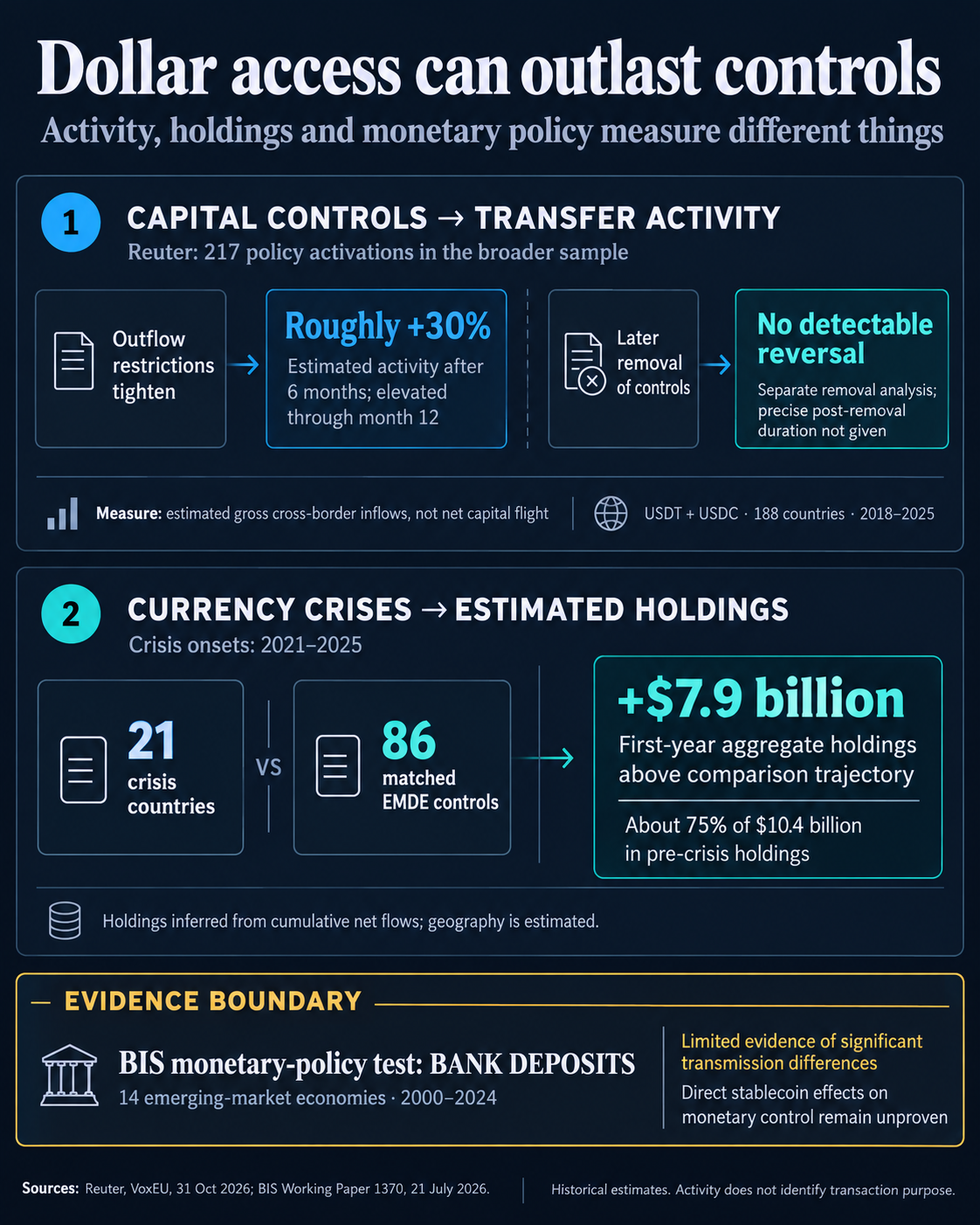
In a separate evaluation of subsequent removals, he experiences no detectable retreat. He additionally says the information reject the speculation that removals absolutely reverse the preliminary enhance. The column doesn’t give a exact post-removal length.
The totally different responses to tightening and elimination have a sensible coverage consequence. If exercise merely tracked the presence of a restriction, easing it ought to carry exercise again down. The reported sample as a substitute means that lifting controls alone could also be inadequate to return stablecoin use to its earlier degree.
The timing issues. The column was printed in October 2026, however the underlying $USDT and $USDC panel covers 188 international locations throughout 2018–2025.
Reuter measures exercise utilizing cross-border stablecoin inflows. That may reveal a bigger marketplace for greenback entry with out establishing that extra wealth has left the nation on a web foundation. Gross receipts and web capital outflows reply totally different questions.
Nation attribution additionally introduces uncertainty. Reuter assigns places probabilistically utilizing pockets exercise and change web site audiences.
Holdings are one other distinct measure. Reuter approximates them via cumulative web flows, together with transfers involving issuers; these estimates rely upon inferred pockets places and transaction protection.
His separate currency-crisis comparability experiences mixed estimated holdings rising about $7.9 billion above the comparison-country trajectory over the primary 12 months. That equals roughly 75% of the disaster international locations’ $10.4 billion pre-crisis holdings. The pattern includes 21 disaster international locations throughout 2021–2025 and 86 matched rising and creating management economies.
What persistence means for financial management
The BIS research printed July 21, by Boris Hofmann, Aaron Mehrotra and Jan Paulick, additionally finds persistence in greenback deposits and stablecoin exercise. It experiences restricted proof that the 2 types of greenback publicity substitute for each other.
Its restrictions findings look totally different from Reuter’s: estimated stablecoin-flow responses aren’t statistically vital. However the research don’t run the identical take a look at.
The BIS working paper makes use of Chainalysis gross $USDT and $USDC inflows throughout 184 international locations throughout 2017–2024. It allocates transfers involving entities similar to exchanges utilizing web site visitors. Reuter’s panel ends a 12 months later and makes use of a distinct wallet-location mannequin. The BIS research’s broad deposit panel, in the meantime, covers greater than 130 economies throughout 1990–2019, a for much longer historic file than both stablecoin dataset.
Their coverage comparisons differ too. Reuter research adjustments round activations. BIS contains comparisons throughout restriction regimes and quarterly Latin American panels utilizing weighted restriction indices and stablecoin-specific guidelines. An affiliation with the principles in place is totally different from a response across the month a rule adjustments.
These variations stop a easy verdict that one research disproves the opposite. Nor does a statistically insignificant estimate set up that restrictions can by no means have an effect on stablecoin use.
Dollarization can imply individuals holding international forex as a substitute of home cash. Demonstrating that desire is totally different from measuring whether or not a central financial institution’s interest-rate choices grow to be much less efficient.
The BIS researchers tackle financial transmission utilizing deposit dollarization and coverage surprises in 14 emerging-market economies throughout 2000–2024. They discover restricted proof of serious variations in transmission by deposit-dollarization degree. That take a look at doesn’t estimate the direct causal impact of stablecoin adoption.
Additionally they discover average deposit dollarization related to considerably larger inflation dangers.
The authors warn that have with deposits might not translate adequately to tokens circulating past regulated banks and serving totally different functions.
CryptoSlate’s earlier protection of crisis-linked stablecoin demand examined the enforcement problem created by greenback entry exterior home banking channels. The post-removal proof extends that dialogue by asking whether or not the choice stays in use after the unique restriction ends.
For authorities easing controls, the sensible implication is to maintain measuring digital-dollar use after the rule adjustments. A decline in transfers, a decline in greenback holdings and a stronger response to home rates of interest would every inform a distinct story.