
Bitcoin pockets Electrum has patched a safety flaw that allowed hackers to redirect funds when customers tried to extend transaction charges.
The builders disclosed the vulnerability on Oct. 24, confirming that malicious servers had exploited the weak point and that at the very least one consumer misplaced Bitcoin after unknowingly approving a fraudulent transaction.
The high-severity vulnerability impacts Electrum variations sooner than 4.8.3. It exploits the pockets’s reliance on exterior servers to trace unconfirmed transactions, permitting attackers to govern the fee info customers see earlier than they authorize extra charges.
The disclosure adopted two complaints acquired on Oct. 11 and Oct. 18. The primary consumer observed an unfamiliar transaction showing of their pockets after broadcasting a fee, whereas the second reported dropping funds after trying to speed up a pending switch.
Each incidents concerned attackers producing Bitcoin addresses that matched the ultimate 4 characters of the meant recipients’ addresses, doubtlessly deceiving customers who relied on partial tackle checks.
Electrum didn’t disclose the quantity stolen, though its maintainers confirmed that some servers had been actively finishing up the assault.
How hackers turned Bitcoin price changes into unauthorized funds
The exploit takes benefit of a weak point in how Electrum processes transaction info provided by its linked servers.
When a consumer broadcasts a Bitcoin fee, a malicious server can withhold the transaction from the community and as a substitute provide a conflicting model that redirects the funds to an attacker-controlled tackle.
The fraudulent transaction initially accommodates invalid signatures, that means it can’t be processed as a reliable fee. Nevertheless, affected Electrum purchasers did not confirm these signatures earlier than displaying the substituted transaction within the pockets’s unconfirmed historical past.
Consequently, the reliable fee disappears from that view, leaving the consumer with a manipulated transaction that seems to be awaiting affirmation.
The attacker can then exploit Bitcoin’s Exchange-by-Price characteristic, which permits customers to extend transaction charges to encourage miners to substantiate delayed funds.
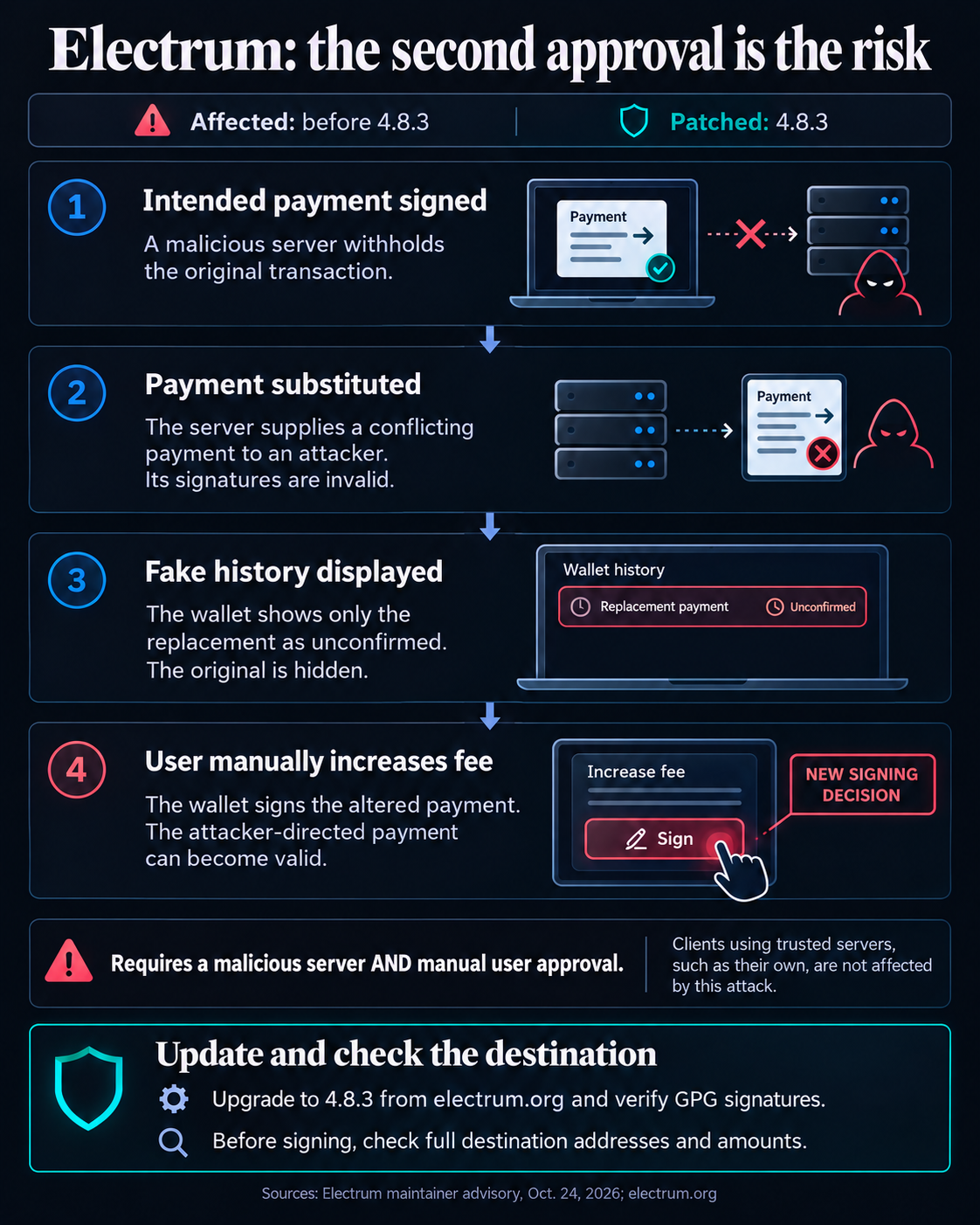
If the sufferer manually will increase the price on the substituted transaction, Electrum generates contemporary signatures authorizing its altered fee particulars. That approval makes the attacker-directed transaction legitimate, permitting the funds to switch with out compromising the consumer’s personal keys.
Within the Oct. 18 incident, the attackers reportedly set the fraudulent transaction price to zero, doubtlessly encouraging the sufferer to lift it.
The case reveals how a routine pockets operate can change into a theft mechanism when the consumer accepts transaction particulars from an untrusted server with out enough verification.
Electrum’s newest launch introduces signature checks for wallet-owned inputs earlier than unconfirmed transactions enter the consumer’s native historical past, stopping the reported substitution approach from reaching the fee-adjustment stage.
The builders tagged model 4.8.3 on Oct. 23 and distributed the up to date software program on Oct. 24, alongside the general public safety disclosure.
They suggested customers to obtain the patch from Electrum’s official web site and confirm full recipient addresses and fee quantities each time signing transactions.
The advisory additionally says purchasers linked completely to trusted servers, together with privately operated ones, aren’t uncovered to this assault. The patch doesn’t lengthen signature verification to each incoming transaction.