Management over a downloaded interface issues as a result of the accepted code sits between a fee instruction and the signature authorizing it. Selecting when that code modifications can scale back one recurring publicity, whereas its dependencies and signing entry decide what the put in software program can do.
Retaining a duplicate modifications the supply resolution
The sensible achieve is the power to maintain a selected utility revision moderately than acquiring the web site interface once more on every go to. Accepting a alternative revision creates one other supply resolution. For this source-build route, that call additionally entails the dependency set and the instruments that flip supply into executable software program. A well-recognized undertaking identify alone doesn’t describe all of the code being accepted.
Kohaku-cli handles public Ethereum accounts and personal balances on Twister Money, Railgun and Privateness Swimming pools V1. It’s a specific pockets utility, distinct from the broader Kohaku toolkit of reusable protocol libraries and pockets infrastructure. Its warning ought to be learn at that utility stage, moderately than as an audit verdict on each part or protocol it makes use of.
The documented set up route additionally reveals what “native” entails. The undertaking’s directions name for putting in dependencies with npm set up, constructing the applying with npm run construct, and operating an area launcher. At commit 0ef5c44, the documentation, manifest, lockfile and implementation describe the identical utility revision. Its manifest identifies model 0.1.0 and requires Node.js 22 or later. Buterin’s account doesn’t establish his put in revision.
The manifest fixes direct dependency variations, together with viem and a number of other Kohaku packages. It additionally pins a separate kohaku-artifacts Git dependency to a commit. The corresponding lockfile information resolved registry packages and integrity hashes. The appliance due to this fact has a software program provide chain even when its interface runs on the consumer’s machine.
Preparation can already contain a signature
Kohaku-cli’s public-transfer and Railgun unshield paths present why a pause earlier than submission can imply various things. An strange public-transfer dry run returns with out sending the transaction; a ready Railgun unshield can already include a signature.
For an strange, non-batched public switch, the switch implementation simulates the transaction and returns dry-run output with out submission. The published path requires the sender’s non-public key, constructs an area pockets consumer and sends the transaction. The wallet-client code derives its signing account from that personal key.
Non-public operations expose a further wrinkle. The unshield command can output a ready Railgun UserOperation that’s already signed, even when broadcasting is withheld. A UserOperation is an account-operation payload that appropriate tooling can submit. The separate broadcast implementation expects a signed operation after which sends it by means of a Pimlico bundler.
For that path, withholding submission can nonetheless go away a signed operation prepared for appropriate tooling to submit later. Calling the end result “ready” due to this fact doesn’t make it universally unsigned. Software program which will assemble an authorization, software program which will signal it and software program which will submit it have to be assessed as distinct sources of authority, even when one CLI coordinates them.
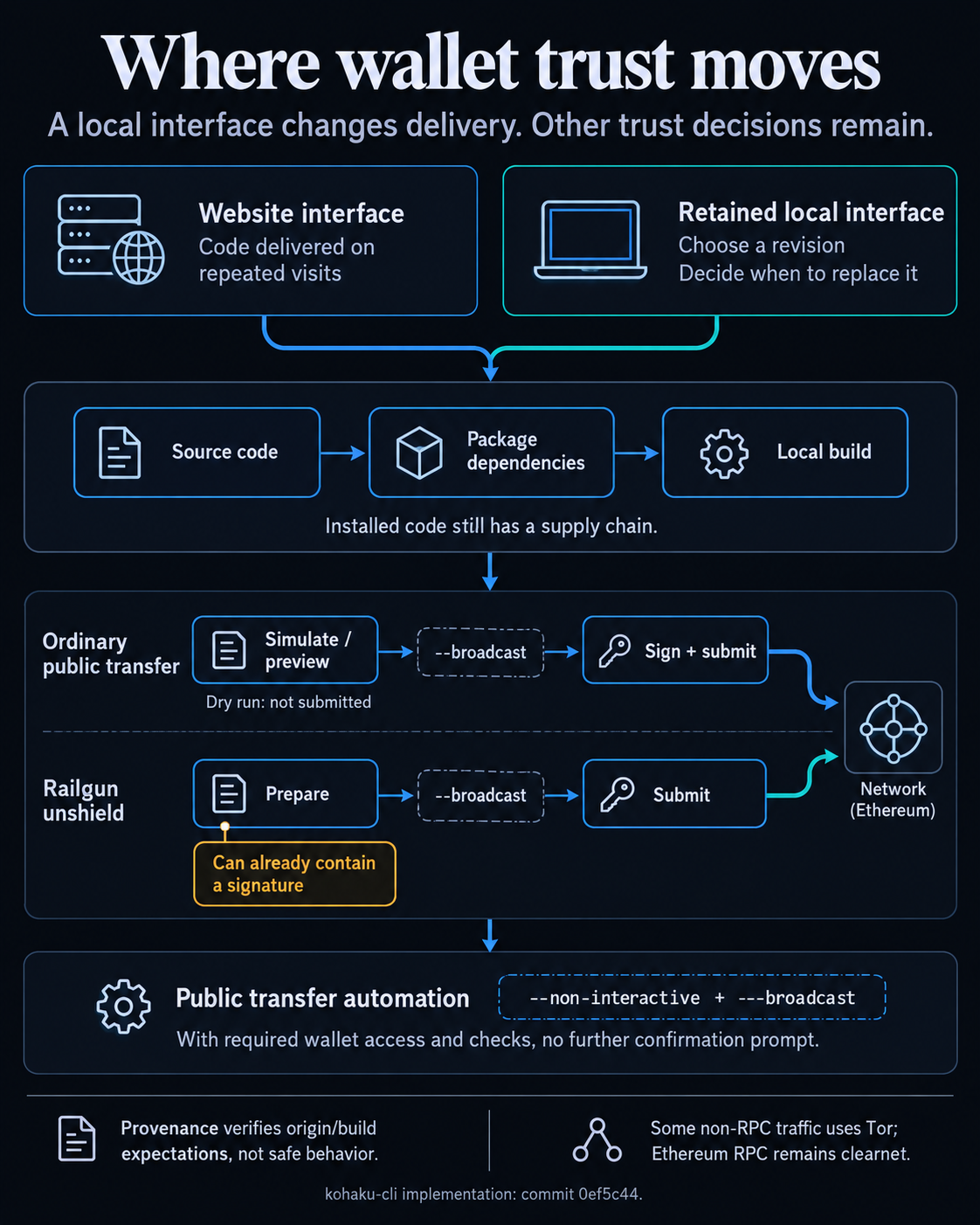
Human affirmation is one other separate selection. Within the inspected public-transfer path, a suitably configured caller with pockets entry can use --non-interactive along with --broadcast to submit and not using a additional affirmation immediate. Pockets unlocking, required parameters, chain matching and simulation checks nonetheless apply. The potential is related to scripts and brokers; it doesn’t reveal whether or not Buterin makes use of unattended funds.
The README describes an encrypted seed on disk and owner-restricted password information for POSIX automation. These measures govern saved secrets and techniques and the way a course of obtains entry to them. They don’t, by themselves, set up an impartial spending restrict or recipient coverage as soon as the method can use the signer.
CryptoSlate has beforehand lined the wallet-permission downside for native AI. Supply management provides one other dimension: a consumer can retain a selected interface revision, whereas that code operates inside no matter signing and submission authority it receives.
Provenance checks origin, with a separate query about habits
Software program provenance presents a technique to look at the supply facet extra rigorously. It information the place an artifact got here from and the way it was constructed. The SLSA verification normal describes checking a provenance signature, matching the artifact’s digest, recognizing a trusted builder and evaluating the said supply and construct parameters with anticipated values.
These checks may help distinguish an anticipated construct from a substituted artifact or an unintended construct supply. They nonetheless rely upon which builders and supply expectations the verifier trusts.
Dependency checking stays its personal process. SLSA describes recursive verification of resolved dependencies as an elective further step. Authenticating the top-level artifact doesn’t robotically authenticate each enter to it.
Appropriate origin and construct historical past can accompany utility logic that the consumer would nonetheless reject.
Community privateness is equally separate from utility supply. The CLI documentation describes Tor by default for sure non-RPC site visitors whereas Ethereum RPC stays on the strange community connection. Working the interface domestically due to this fact doesn’t make each exterior interplay non-public. Earlier Kohaku and verified-RPC protection involved one other a part of this broader belief downside.
Buterin’s experiment factors to a concrete type of consumer management: selecting the applying code that stays on the machine and deciding when to simply accept alternative code. Its worth depends upon carrying that management by means of dependency choice and the signer.