
Three weeks later, the reply grew to become tougher to disregard.
Between November 2 and 20, Bitcoin ETFs suffered a staggering $4.14 billion in web withdrawals, in keeping with Farside Buyers. By the best way, IBIT ALONE accounted for about $3.49 billion, or 84% of the exodus.
And the promoting gathered tempo because the week wore on. Practically $1.79 billion left within the remaining week, round 1.7 instances the earlier week’s withdrawals. From November 17 by November 20, every buying and selling session ended with a bigger outflow than the earlier one.
October’s greatest supply of assist had grow to be November’s greatest supply of strain. The reversal was putting sufficient. In actual fact, what was occurring beneath it was extra revealing!
October regarded high quality… till it didn’t
BlackRock’s affect on the business’s efficiency was hardly a one-week curiosity.
The sample continued into October 26–30. IBIT attracted one other $176.9 million whereas competing funds collectively misplaced $379.3 million. Although the business completed that week within the purple, BlackRock’s inflows successfully absorbed practically half the injury.
Then, on October 30, the reprieve ended.
Spot $BTC ETFs recorded roughly $643 million in withdrawals in a single session, with IBIT contributing roughly $234 million. The fund that had been cushioning the business’s losses was now collaborating in them.
November made that reversal unmistakable.
IBIT accounted for about 94% of the business’s web outflows through the first week, 85% through the second, and 76% through the third. Curiously, its share declined even because the third week introduced the business’s greatest outflow but.
That was the extra consequential growth. Different funds, together with Constancy’s FBTC and merchandise from Grayscale and ARK, had been contributing more and more to the promoting. What had initially been concentrated overwhelmingly in BlackRock’s product was starting to unfold.
A market as soon as held up by its largest fund was now being dragged down by it, with rivals more and more becoming a member of the retreat.
Now, IBIT was already by far the business’s greatest fund. Maybe its dominance within the withdrawals was merely a consequence of its dimension. Therefore why that risk deserved a better look. Nevertheless, a better take a look at this place revealed one other complication.
Large fund, larger exit!
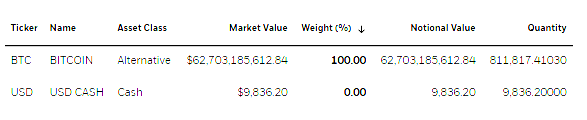
A fund holding a lot of the business’s property will naturally account for a big share of its actions. A billion {dollars} leaving a $60 billion product is hardly equal to the identical quantity leaving one value $5 billion.
By October 30, IBIT held roughly $62.7 billion in Bitcoin, in keeping with iShares holdings information. Taking a look at it broadly, the Bitcoin ETF market held roughly $98.14 billion, based mostly on SoSoValue.
BlackRock due to this fact managed about two-thirds of the business’s property getting into November. And but, it accounted for 84% of the following three-week web withdrawals.
The disparity solely turns into sharper when adjusted for dimension.
IBIT’s $3.49 billion outflow was equal to roughly 5.6% of its beginning holdings worth. For all the opposite funds mixed, the equal was simply 1.8%.
In relative phrases, BlackRock’s fund skilled roughly thrice the withdrawal strain of its rivals. Its scale defined a part of its dominance, however hardly all of it.
The underlying Bitcoin stock tells the same story. IBIT held roughly 811,817 $BTC on October 30. By November 20, that had fallen to roughly 760,926 $BTC, a discount of practically 50,900 $BTC or 6.3%.
Bitcoin’s declining value may cut back the greenback worth of these holdings, nevertheless it couldn’t account for the disappearance of the cash themselves. IBIT’s stock had genuinely contracted.
The departures had been measurable. The identities of these departing had been one other matter.
A $4 billion ETF outflow makes it tempting to declare that institutional traders are abandoning Bitcoin. But the obtainable information can’t distinguish an asset supervisor decreasing publicity from a person investor promoting shares, or a market participant unwinding a hedged place.
Nor does it set up whether or not the capital left Bitcoin altogether or discovered one other route again into the market. That uncertainty issues as a result of the business has grown comfy treating ETF inflows as proof of institutional conviction. Making use of the alternative interpretation to withdrawals could also be tempting, however it’s no extra conclusive.
What November demonstrated was a considerable withdrawal of capital from these funding merchandise, led disproportionately by BlackRock’s IBIT.
Whether or not it represented a broader lack of religion in Bitcoin was a significantly bigger query although.
And whereas traders had been heading for the exits, there appeared to be little indication that the fund itself had stopped functioning as supposed.
The fund labored. Bitcoin nonetheless fell.
There’s an comprehensible tendency to interpret massive ETF outflows as an indication that the funding product itself has someway failed. Nevertheless, IBIT’s buying and selling information tells us a extra measured story.
Based on iShares, IBIT closed at $33.02 on November 20 in opposition to a web asset worth of $33.05, a reduction of about 0.10%. Its 30-day median bid-ask unfold was 0.02%. In different phrases, the fund traded nearly precisely on the worth of the Bitcoin it holds, at the same time as markets had been falling.
Buying and selling was heavy. About 109.2 million IBIT shares modified fingers on November 20, greater than twice the fund’s 30-day common of about 50.1 million.
That’s not the identical as cash leaving the fund although as a result of buying and selling quantity is just not web movement. A 30-day median unfold additionally doesn’t present that buying and selling stayed low-cost at each risky second.
Nonetheless, nothing right here suggests traders had been fleeing a damaged product. They had been buying and selling a working fund whose underlying asset had dropped sharply. IBIT’s NAV fell $2.08 (5.92%) on November 20 to $33.05, and its NAV complete return for 2026 stood at −29.06% as of November 19.
Wall Road made Bitcoin simpler to purchase. That was by no means the identical promise as making it safer to carry. That distinction issues for the query that comes subsequent — how a lot of the autumn in ETF property was cash leaving, and the way a lot was the value?
Based on SoSoValue, mixed Spot Bitcoin ETF property reached roughly $110.8 billion on October 5. By November 20, they’d fallen to roughly $71.3 billion.
A decline approaching $39.5 billion sounds extraordinary beside three weeks of roughly $4.14 billion in web withdrawals.
Nevertheless, property beneath administration signify the market worth of what these funds maintain. That worth adjustments each when traders create or redeem shares and when Bitcoin itself rises or falls.
Utilizing Coinbase Bitcoin costs recorded by the Federal Reserve Financial institution of St. Louis, Bitcoin fell from roughly $85,821 on October 5 to $58,831 on November 20 — A fall of 31.4%.
Over the identical interval, reported ETF property fell by roughly 36%.
Such a comparability strongly means that Bitcoin’s value decline accounted for a lot of the discount in ETF asset values. It’s not a exact decomposition — flows occurred all through the interval, holdings modified, and the dates and valuation methodologies should be matched earlier than assigning an actual proportion to every driver.
Nonetheless, the broad conclusion is troublesome to overlook.
Tens of billions of {dollars} can disappear from reported fund asset values with out an equal sum being withdrawn by traders. A falling portfolio worth and a redeemed funding are two completely different monetary occasions. Treating them interchangeably provides a dramatic headline significantly extra authority than it deserves.
The difficulty prolonged past Bitcoin
Bitcoin’s ETF market was not the one place seeing withdrawals both.
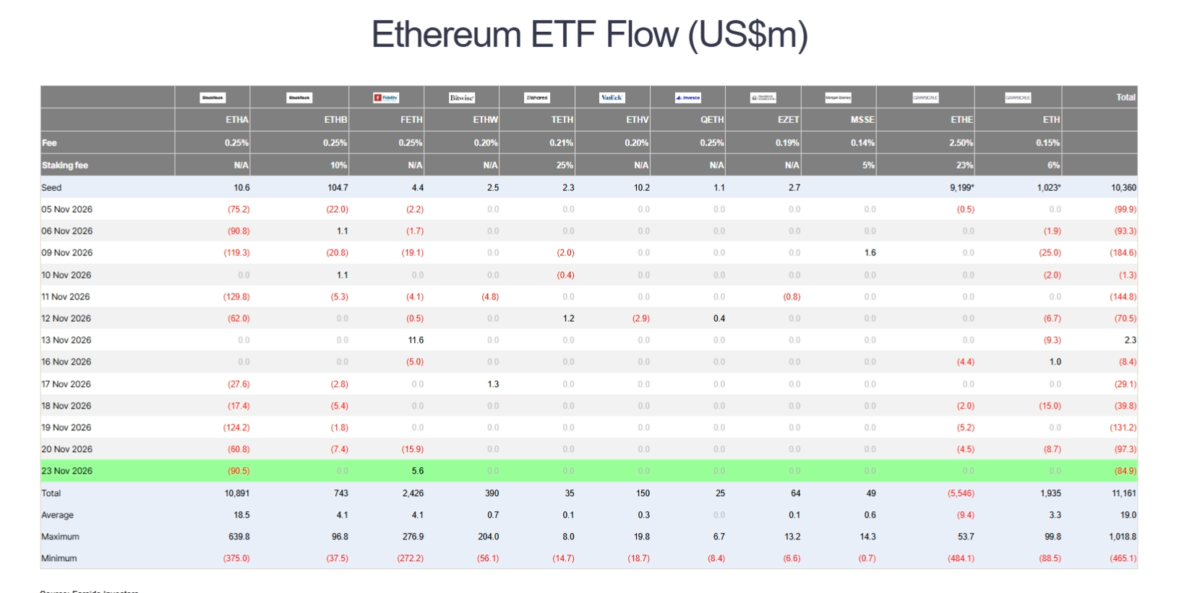
From November 9 to 13, U.S Spot Ether ETFs misplaced about $398.9 million, in keeping with Farside. BlackRock’s iShares Ethereum Belief (ETHA) accounted for about $311.1 million of that, or 78%. The next week, Ether funds misplaced about $306 million, with ETHA accountable for about $230 million or 75%.
That’s the identical sample we noticed in Bitcoin — one BlackRock fund carrying a lot of the headline outflow.
Stablecoins informed a slower story. Based on DefiLlama, their mixed market capitalisation was about $295.3 billion on October 30. It fell to $290.2 billion by November 6, $285.6 billion by November 13, and $281.3 billion by November 20. That could be a contraction of about $14 billion, or 4.8%, in three weeks.
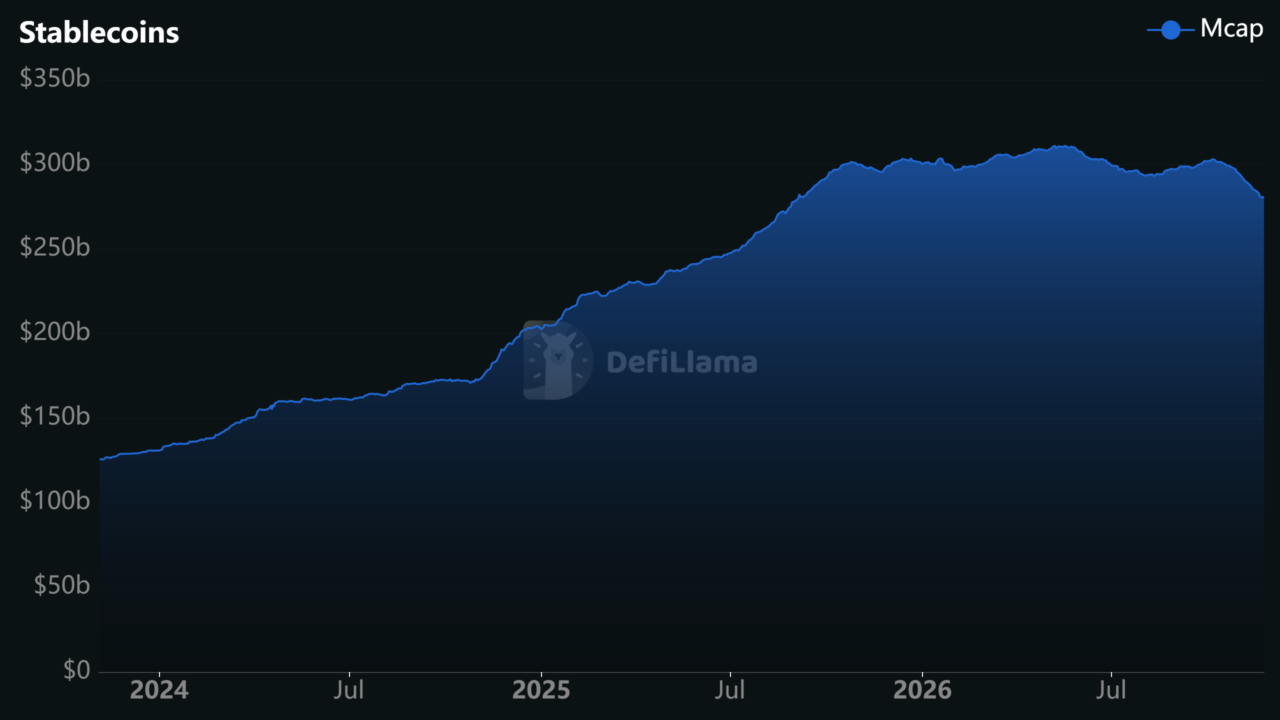
In contrast to the ETF flows, which peaked within the remaining week, stablecoins shrank at a reasonably regular tempo — about $5.1 billion, $4.6 billion, then $4.3 billion per week.
Stablecoins are the dollar-pegged tokens merchants use for settlement, buying and selling balances, and collateral. So, a falling provide suggests liquidity could also be tightening past the regulated ETF market. The 2 traits overlapped, however they moved at completely different speeds.
Bitcoin’s personal buying and selling schedule provides a complication too.
FRED’s Coinbase sequence confirmed Bitcoin falling from about $68,178 on November 13 to $62,891 on November 14, a drop of seven.8%, after that week’s ETF periods ended.
Nevertheless, after the a lot heavier withdrawal week ending November 20, Bitcoin went the opposite approach. It fell from about $58,831 on November 20 to $60,992 on November 22 — A achieve of three.7%.
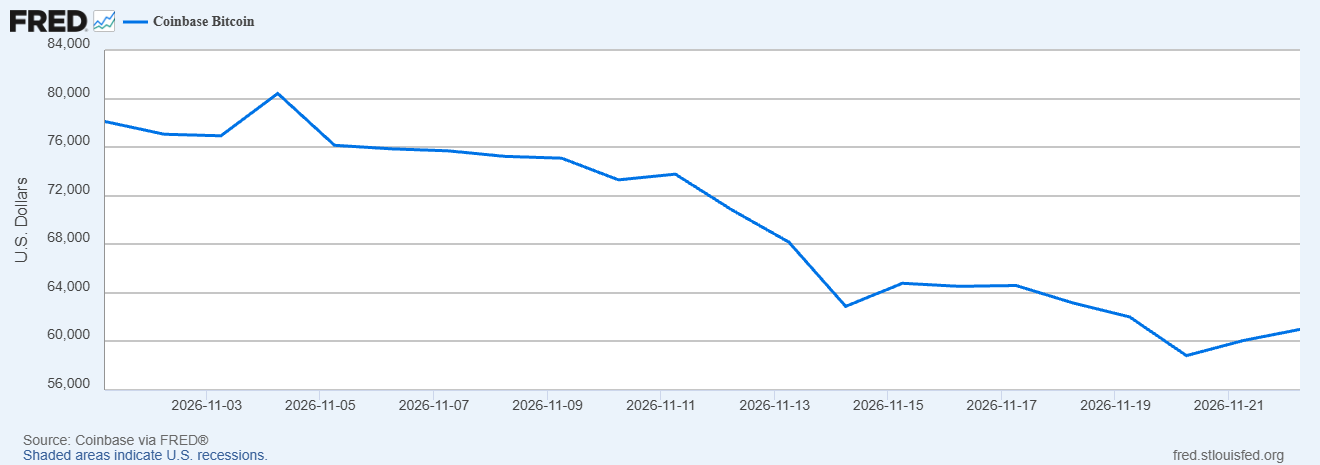
Two weekends show nothing on their very own, and FRED’s costs are taken at 5 p.m Pacific, not on the ETF shut. However they do present {that a} file ETF outflow and a falling value don’t transfer in lockstep.
What the $4 billion really tells us
There is no such thing as a have to minimise the withdrawals. About $4.14 billion in three weeks is a serious reversal, notably when the ultimate week was the worst of the three.
Nor ought to IBIT’s focus be disregarded as a consequence of its dimension. Its 84% share of the online outflows exceeded its roughly two-thirds share of beginning business property.
Nevertheless, context adjustments the interpretation.
SoSoValue’s November 20 figures nonetheless confirmed about $52.8 billion in cumulative web inflows since January 2024. That’s down roughly $4 billion from the place November started, however practically three years of collected inflows weren’t erased by three troublesome weeks.
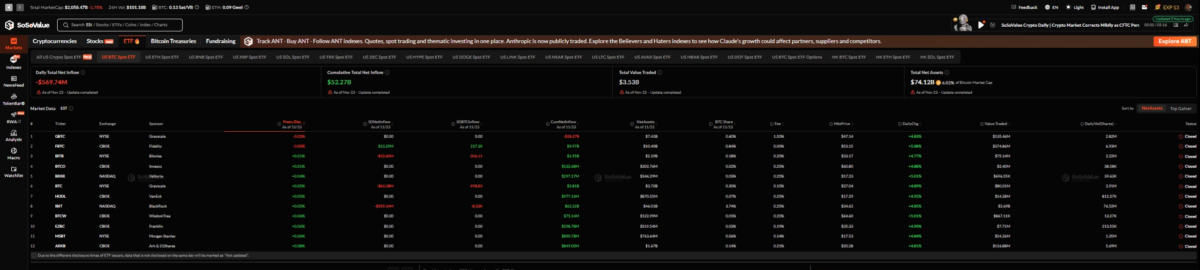
October presents a helpful warning about studying any headline in isolation. The identical fund that masked withdrawals elsewhere in two October weeks went on to account for many of November’s exits. The business totals recorded each developments precisely, but informed very completely different tales relying on whether or not you regarded on the funds behind them.
The ETF construction broadened entry to Bitcoin. It additionally gave traders a well-recognized, liquid approach to cut back publicity. Neither is a assure about Bitcoin’s value.
Maybe establishments had been reducing threat. Or, retail traders might have been heading for the exits. Others may merely have been unwinding complicated positions that had little to do with long-term conviction in Bitcoin. All three are believable explanations.
What they do set up is narrower however extra helpful — the withdrawals had been substantial, closely concentrated in a single product, and more and more shared throughout competing funds as November went on.
So, the following time a billion-dollar ETF outflow makes the headlines, the fascinating questions start after the headline. Which funds accounted for it? How massive had been the withdrawals relative to their property? Is the quantity cash leaving a product, or is the market worth of its holdings falling?
And another, which no movement desk can reply — Who was really promoting?
Remaining Abstract
- U.S Spot Bitcoin ETFs recorded roughly $4.14 billion in web withdrawals between November 2 and 20, with BlackRock’s IBIT accounting for 84%.
- And but, IBIT held solely about 64% of the business’s property getting into November.