
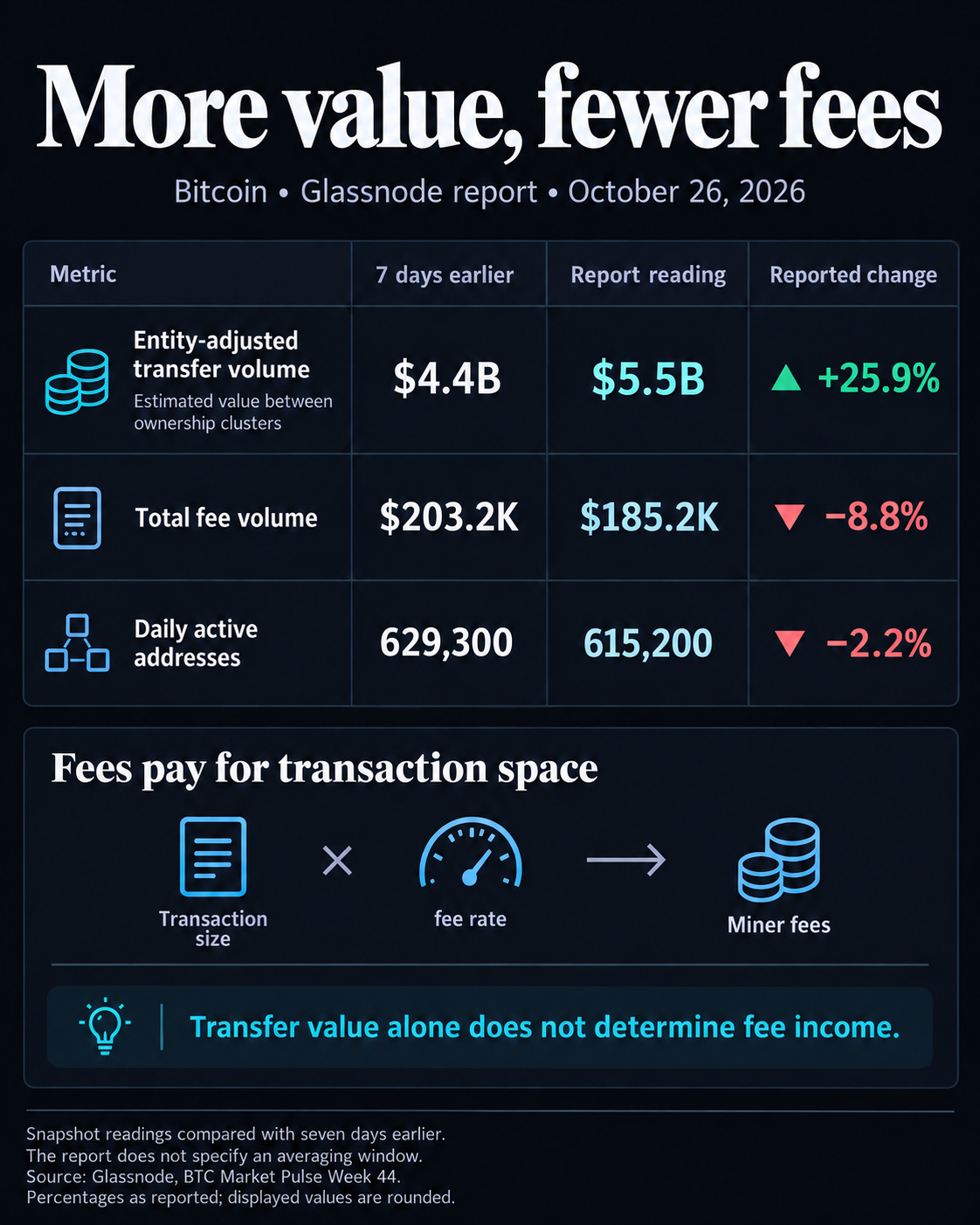
Transaction charges account for lower than 1% of Bitcoin miner income
Bitcoin miners sometimes earn income from two sources: newly issued $BTC awarded for producing blocks and transaction charges paid by customers competing for restricted blockspace.
When community exercise will increase, customers might provide greater charges to safe quicker transaction confirmations, boosting miners’ earnings. Nevertheless, charges depend upon competitors for blockspace fairly than the greenback worth transferred, that means even massive Bitcoin transactions can generate comparatively little income.
This competitors has remained subdued regardless of rising switch volumes. Earlier this month, CryptoSlate reported that Bitcoin miners’ each day income climbed again above $40 million, with transaction charges accounting for lower than 1% of their revenue.
Mining evaluation platform Pool $BTC illustrated the disparity utilizing community exercise from the 24 hours via Oct. 25, when miners produced 158 blocks and earned roughly 494 $BTC in subsidies price $39.5 million.
Transaction charges added simply 1.88 $BTC, price roughly $150,000, equal to 0.38% of subsidy income.
The imbalance has endured past a single reporting interval. Pool $BTC famous that charges accounted for simply 0.69% of miner income on Aug. 11, citing Glassnode information, and have remained beneath 1% for a lot of the previous 12 months.
That dependence leaves miners closely uncovered to Bitcoin value fluctuations and the scheduled discount in block rewards, which at present present almost all their revenue.
The subsequent halving, anticipated in 2028, will cut back the subsidy from 3.125 $BTC to 1.5625 $BTC per block. Except competitors for blockspace strengthens sufficient to elevate transaction charges, miners will want greater Bitcoin costs or decrease working prices to offset the discount in newly issued cash.