Three Mining Swimming pools Command Practically 60% of Monero’s Hashpower
Mining distribution figures from Miningpoolstats present SupportXMR main the pack with roughly 1.87 GH/s, adopted by Nanopool at 1.23 GH/s and Kryptex at 1.17 GH/s. Collectively, these three swimming pools signify roughly 4.27 GH/s, or 60% of the estimated community whole. SupportXMR alone accounts for roughly 26.3%, whereas Nanopool and Kryptex signify roughly 17.3% and 16.4%, respectively.
Hashvault follows with 730.76 megahash per second (MH/s), whereas C3Pool contributes 481.17 MH/s. P2Pool’s largest listed phase provides one other 473 MH/s, providing miners a decentralized different to traditional pool operators. The figures don’t set up that three entities personal 60% of Monero’s mining gear. Pool operators coordinate computing energy contributed by unbiased miners, who can redirect their machines elsewhere.
However, the distribution exhibits how mining coordination can grow to be concentrated even when participation stays technically accessible.
Monero Mining Pool Distribution, Oct. 26, 2026
Supply: Miningpoolstats, Oct. 26, 2026, at 6 p.m. ET. Community hashrate estimated at 7.12 GH/s. Percentages are approximate, and P2Pool figures replicate its largest listed phase.
Qubic’s 2025 Mining Offensive Nonetheless Looms Giant
Monero’s elevated hashrate follows a contentious 2025 marketing campaign through which Qubic directed substantial outdoors computing sources towards the community. Qubic claimed it quickly managed greater than 51% of Monero’s hashrate, equal to roughly 2.7 to three GH/s on the time. Quick blockchain reorganizations and orphaned blocks accompanied the episode, though the community continued working.
The confrontation rocked discussions about Monero’s safety mannequin, significantly whether or not CPU-friendly mining alone may forestall coordinated entities from amassing appreciable computing energy. Whereas the community is buzzing alongside at 7.12 GH/s, it’s nonetheless under the all-time excessive logged earlier this 12 months. Coinwarz information exhibits that the Monero community reached 7.54 GH/s at block top 3589072.
RandomX Retains CPUs Aggressive, however Bitmain Enters the Image
Monero depends on RandomX, a proof-of-work (PoW) algorithm launched in November 2019 to favor general-purpose CPUs over standard application-specific built-in circuits (ASICs). RandomX combines random program execution, memory-intensive operations and complicated calculations to discourage the acute {hardware} specialization related to bitcoin mining. Bitcoin’s pool distribution focus is not any higher, as the highest three mining swimming pools command 59.51% on the time of writing.
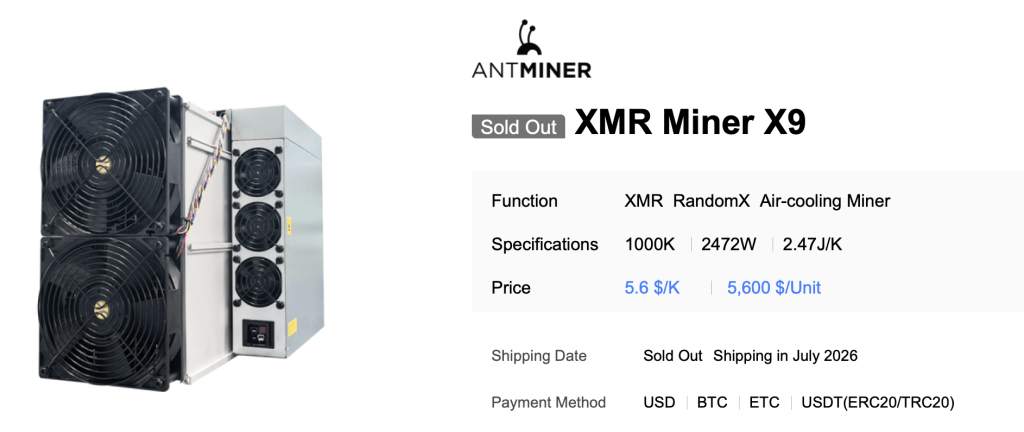
So far as $XMR, Bitmain has challenged the decentralized mining premise with devoted RandomX gear. Its Antminer X5, launched in 2023, delivers roughly 212 kilohash per second (KH/s) whereas consuming 1,350 watts. The X5 unit was offered for $2,999. A Bitmain X9, which delivers 1 megahash per second (MH/s) of hashpower, was offered for $5,599, and will get an estimated $28.27 per day based on present $XMR costs. This makes RandomX the second most worthwhile PoW mining algorithm immediately, just below Zcash’s Equihash. Based on Bitmain’s store, each the X5 and X9 models are offered out.
Monero’s Rising Safety Funds Faces a Decentralization Check
The privateness coin Monero produces blocks roughly each two minutes, awarding miners a everlasting base reward of 0.6 $XMR plus transaction charges. That tail emission creates roughly 432 new $XMR day by day, offering persevering with incentives for miners no matter transaction exercise. Increased community hashrate usually raises the computing sources required to problem Monero’s consensus, however distribution issues as a lot as uncooked computational power.
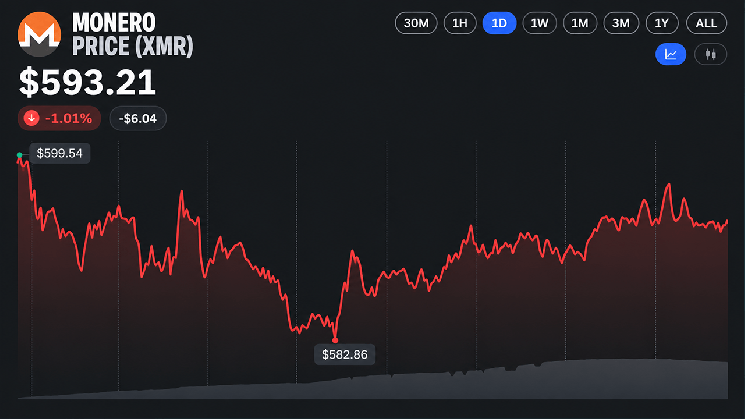
An excessive amount of that power derived from $XMR’s value soar this previous 12 months. Over the past 12 months, monero has climbed 70% towards the U.S. greenback whereas year-to-date stats present a 37% achieve. $XMR’s value almost doubling in worth in a 12 months has clearly attracted mining curiosity throughout a myriad of mining swimming pools, not simply the highest three. In the present day, the most recent figures present the 5 largest listed swimming pools collectively directing roughly 77% of the estimated community hashrate.
That’s a considerable focus of coordinated mining exercise, although the underlying {hardware} might belong to 1000’s of unbiased contributors. For Monero, the urgent query isn’t whether or not its miners can produce extra hashes. It’s whether or not the community can preserve that increasing computing energy sufficiently dispersed to withstand the following coordinated problem.