
Bitcoin ETFs recorded outflows throughout seven of eight main selloffs, difficult expectations that Wall Road traders would assist costs throughout downturns.
A brand new DWF Labs report shared with yourcryptonewstoday discovered that US spot Bitcoin exchange-traded funds persistently misplaced cash throughout market declines of at the least 15% since their January 2024 launch, whereas attracting inflows all through all 9 main rallies.
The findings problem the idea that institutional adoption has created a reliable supply of shopping for throughout market stress. In addition they expose a paradox in Bitcoin’s altering market construction: selloffs have develop into slower and fewer frequent, whilst ETF traders proceed withdrawing billions throughout downturns.
The analysis, overlaying 694 buying and selling days via Oct. 16, discovered that traders withdrew a document $8.2 billion throughout Bitcoin’s 28.8% decline between Could and June 2026. That adopted $6.9 billion in withdrawals throughout the October 2025 to February 2026 downturn, when the cryptocurrency misplaced practically half its worth.
The 2 episodes represented the biggest ETF withdrawals because the merchandise launched, surpassing the $3.4 billion traders redeemed throughout the January-April 2025 correction.
Wall Road traders are shopping for Bitcoin rallies and promoting crashes
DWF Labs discovered that ETF traders had been nonetheless withdrawing cash at seven of eight market bottoms and buying at seven of eight peaks, suggesting institutional flows have largely strengthened present value developments.
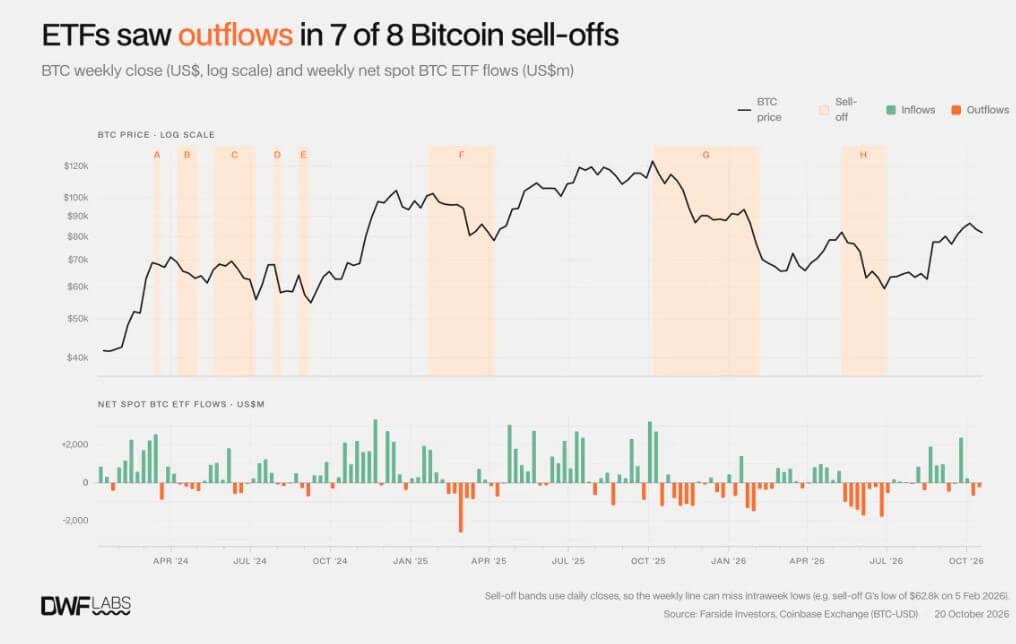
The promoting continuously intensified as downturns progressed. In 5 of the eight corrections, the heaviest withdrawals occurred throughout the last 5 buying and selling days earlier than Bitcoin bottomed.
In the course of the Could-June 2026 decline, outflows averaged $412 million day by day within the last week, whereas traders withdrew cash on 88% of buying and selling days all through the correction.
The sample reversed throughout recoveries, with all 9 rallies of at the least 15% attracting web inflows. Seven recorded their strongest shopping for throughout the last 5 classes earlier than the market peaked.
One notable exception emerged throughout the Could-July 2024 correction, when ETFs attracted $2.2 billion regardless of Bitcoin falling 21.8%. That decline coincided with promoting stress from German authorities liquidations and Mt. Gox creditor repayments, permitting ETF demand to soak up a number of the extra provide.
In any other case, institutional traders have typically waited for recoveries to develop into established earlier than returning.
Throughout Bitcoin’s April 2025 rebound, ETFs continued dropping a median of $40 million day by day even because the cryptocurrency gained 9.7%. Inflows subsequently accelerated to $436 million a day after costs had already recovered.
Conversely, one of many largest ETF influx days, totaling roughly $1.2 billion, coincided with Bitcoin’s October 2025 peak, shortly earlier than a protracted decline.
Bitcoin ETF flows observe costs as a substitute of predicting them
The analysis discovered that ETF flows correlated 0.54 with Bitcoin’s efficiency over the previous 5 buying and selling days, in contrast with simply 0.03 for returns over the next 5 days.
Their correlation with same-day returns was 0.41, suggesting flows and costs usually transfer collectively with out indicating whether or not fund demand drove the transfer.
This weakens the usefulness of ETF inflows as a forward-looking market sign, regardless of their rising prominence in institutional Bitcoin evaluation.
After the biggest 10% of influx classes, Bitcoin appreciated over the next 20 days solely 51% of the time, in contrast with 57% throughout all buying and selling days.
BlackRock’s iShares Bitcoin Belief (IBIT), the market’s largest Bitcoin ETF product, supplied little extra predictive benefit regardless of accumulating $65.6 billion in web inflows throughout the research interval.
Its flows correlated solely 0.04 with Bitcoin’s subsequent five-day returns. Following its largest influx classes, Bitcoin superior over the following 20 days in solely 47% of instances.
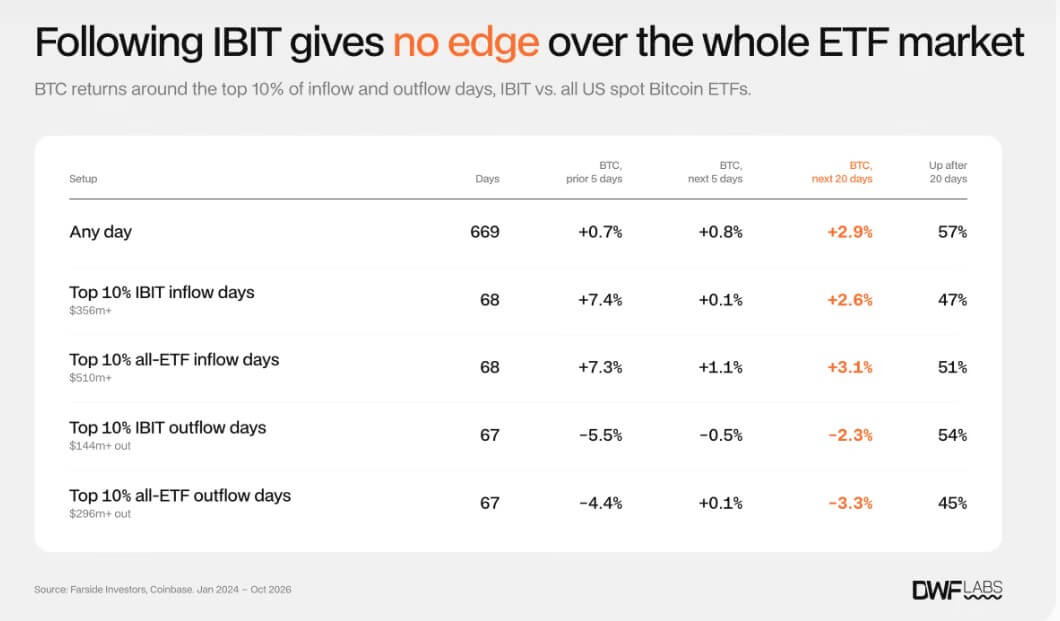
The findings additionally complicate the belief that enormous ETF purchases essentially sign contemporary bullish positioning.
Some exercise displays traders shifting cash between competing funds, whereas hedge funds can concurrently purchase ETF shares and brief Bitcoin futures to seize pricing variations with out betting on the cryptocurrency’s route.
DWF Labs nonetheless recognized one uncommon sample price consideration.
When ETFs skilled unusually giant withdrawals on days Bitcoin moved lower than 1%, the cryptocurrency subsequently declined over 20 days in eight of 12 instances.
Returns following these classes had been 10.7% weaker than on days with comparable previous value developments. Nevertheless, the adverse outcomes had been concentrated round three main selloffs, limiting the sample’s reliability as a buying and selling sign.
Bitcoin crashes have slowed regardless of persistent ETF promoting
Though institutional traders have repeatedly withdrawn cash throughout corrections, Bitcoin’s broader market habits has modified significantly since ETFs started buying and selling.
The median selloff has unfolded at a day by day tempo of 0.69%, in contrast with 1% throughout 2022-2023 and 1.37% in 2021.
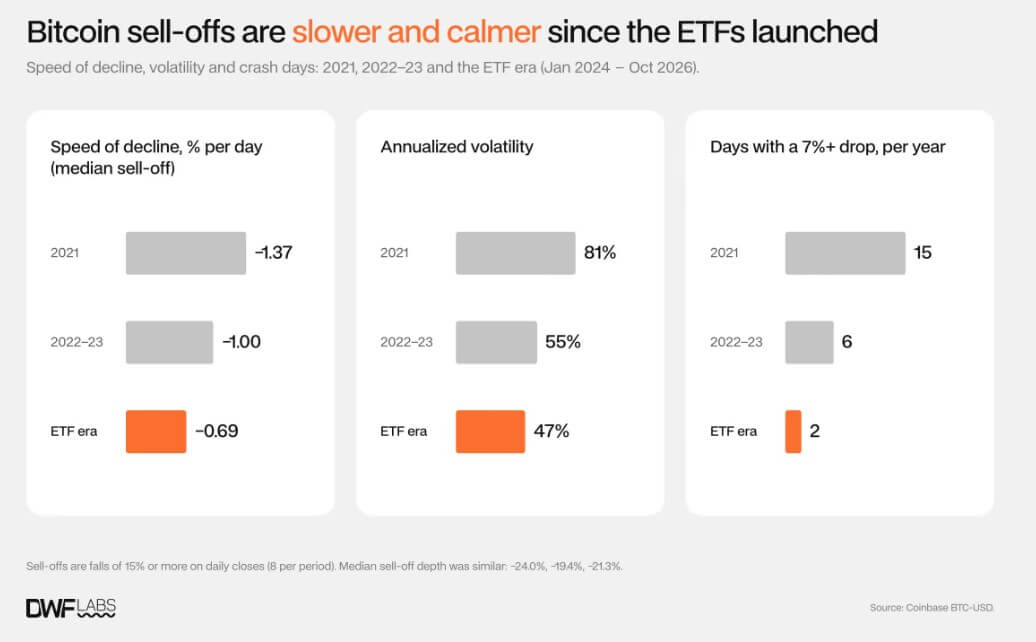
Main corrections of at the least 15% have develop into much less frequent, declining to about 2.9 yearly from 4.4 in 2022-2023 and eight in 2021.
Annualized volatility has additionally fallen to 47% from 55% in 2022-2023, whereas the annual frequency of roughly 7% day by day crashes has dropped from six to 2.
Nevertheless, corrections have remained substantial. The median ETF-era downturn was 21.3%, in contrast with 19.4% throughout 2022-2023.
DWF Labs recognized deeper liquidity, a broader investor base and larger entry to regulated hedging devices, together with CME futures and ETF choices, as potential contributors to the market’s altering habits. Bitcoin’s volatility was already declining earlier than the ETFs launched.
Hedge funds’ positioning gives one other indication of how the institutional market has developed.
DWF Labs estimated that roughly one-fifth of ETF flows could have been hedged via CME futures foundation trades. Leveraged funds’ web brief publicity has since declined from roughly 116,000 BTC in December 2024 to 29,000 BTC.
The agency estimated that unwinding these positions may clarify a lot of the ETF promoting throughout the January-April 2025 correction, however not more than roughly 1 / 4 of withdrawals throughout the two largest subsequent declines.
That means a bigger share of latest outflows mirrored traders actively decreasing Bitcoin publicity.
The report additionally recognized a possible threshold for renewed promoting. As soon as Bitcoin fell 7% beneath its 20-day excessive, common day by day ETF flows shifted from $74 million in inflows to $72 million in outflows over the next 5 buying and selling days.
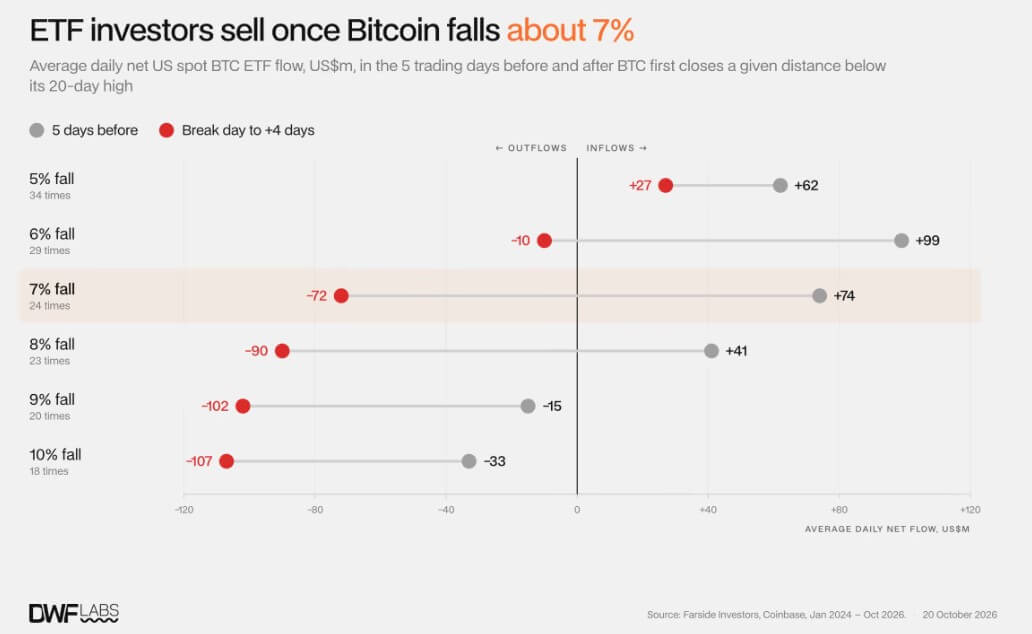
Promoting intensified in 19 of the 24 episodes examined, although flows sometimes returned to impartial ranges over the following two weeks.
The discovering comes as Bitcoin ETFs have pulled in $57.96 billion in cumulative web inflows, with the 12 merchandise managing round $110 billion in property.