The broader PQAI plan, revealed Nov. 23, requires hash-based validator and consumer signatures and hash-based commitments for blob information. The Basis frames that migration as preparation for quantum computing and doable AI-assisted advances in opposition to cryptography.
PQAI #1 recommends the Keccak household throughout that effort, together with signature, blob and recursive aggregation in leanVM, the proof-generating digital machine deliberate for the protocol. Aggregation is meant to make bigger post-quantum signatures sensible.
It’s a household of features, relatively than actually one hash in all places: Keccak-256 for unusual hashing, Keccak-duplex for proof protocols, and SHAKE256 for pseudorandom bit technology and key derivation. All derive from the identical underlying Keccak permutation.
Proving Velocity Modifications the Tradeoff
For years, the Basis assumed post-quantum signatures would wish a proof-friendly hash equivalent to Poseidon as a result of conventional hashes have been too costly to show inside a cryptographic digital machine. The brand new put up says binary-field proof techniques, together with Binius and Flock, and GKR-based provers have eliminated that bottleneck.
The Basis stories that leanVM can show greater than 500,000 Keccak permutations per second on EIP-7870 reference {hardware}, sufficient for its required aggregation throughput. Keccak stays slower to show than BLAKE3 and slower to run natively than SHA2-256.
“We settle for that relative efficiency value for the safety margin and historic cryptanalysis,” put up writer Kev Wedderburn wrote. The leanVM repository labels the software program “not (but) manufacturing prepared.”
The Basis in contrast Poseidon/Poseidon2, BLAKE3, BLAKE2 and SHA2-256 with Keccak-256. Its evaluation favors Keccak’s safety report and integration benefits over the options.
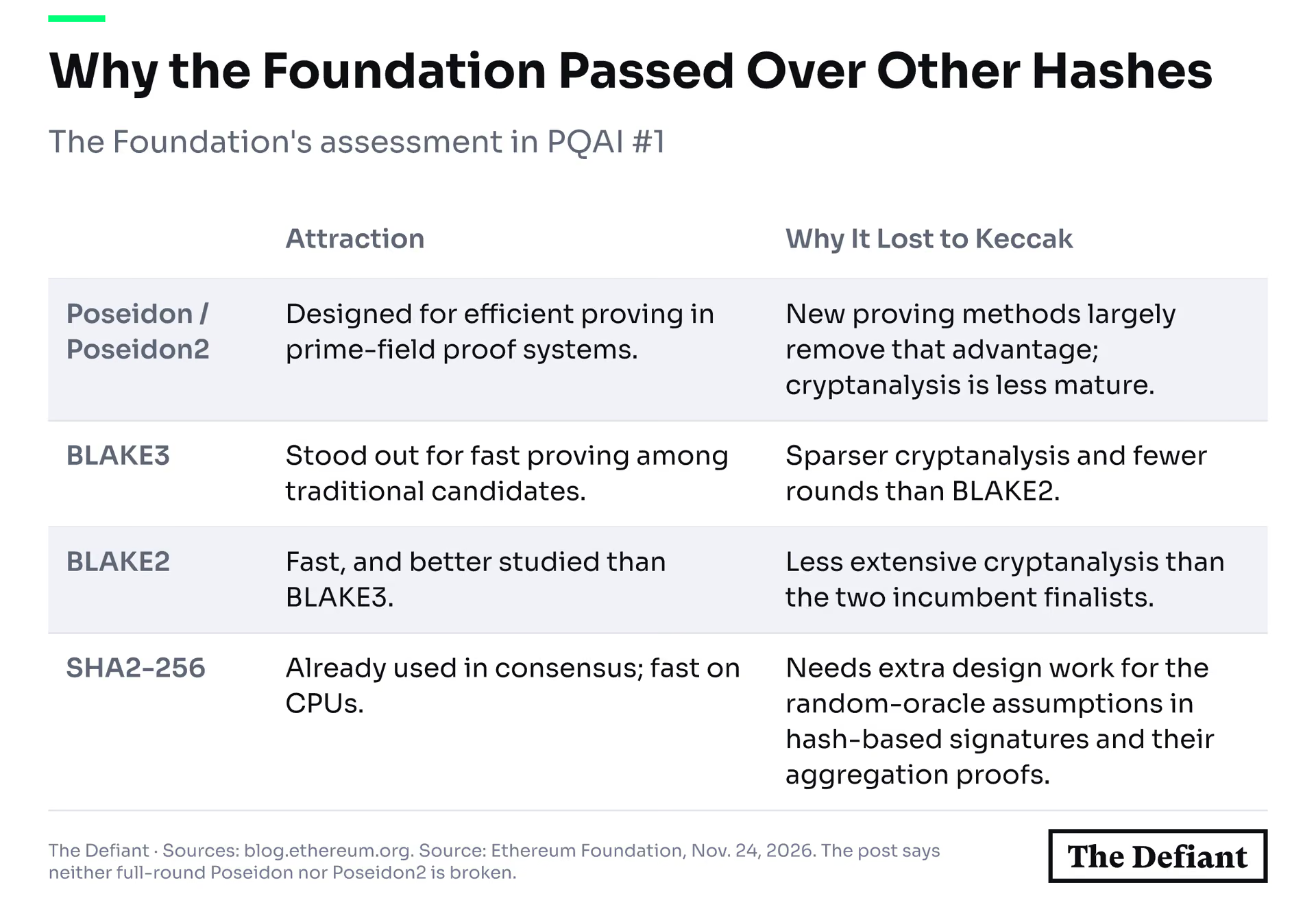
Selecting Keccak-256 over SHA3-256 additionally avoids including a near-identical perform: the 2 differ solely in padding, the put up says. Ethereum already exposes Keccak-256 on to good contracts.
For execution-client builders, the advice means reusing present Keccak implementations for signature verification. Over the long run, it additionally recommends shifting the consensus layer’s SSZ data-tree hashing from SHA2-256 to Keccak-256.