
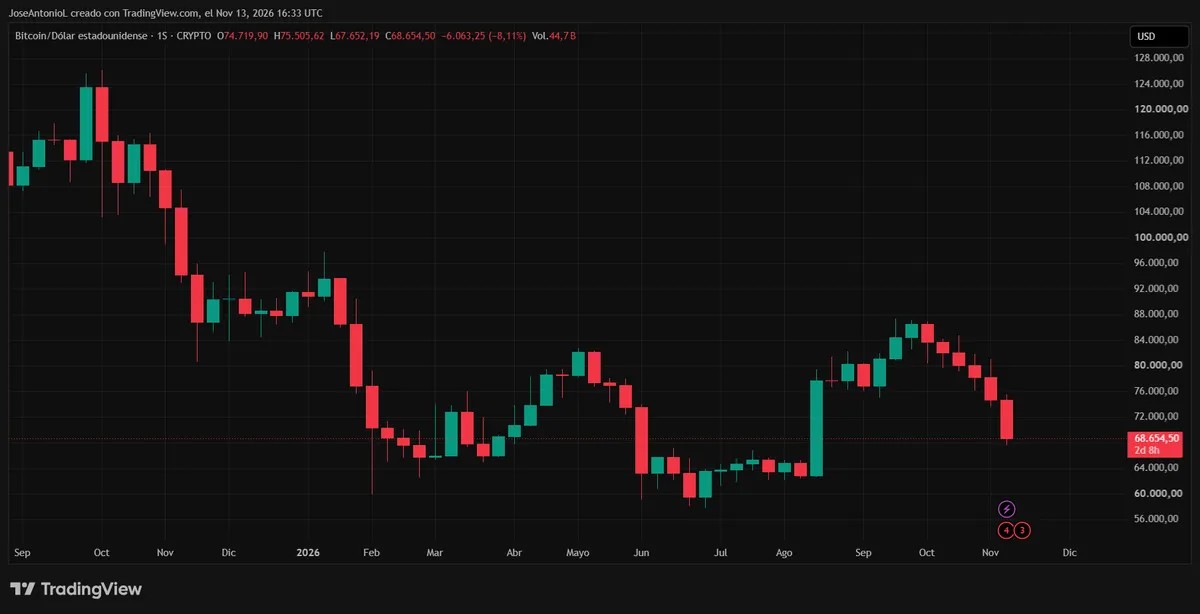
The most recent slide has erased most of Bitcoin’s late-summer restoration. However not all of it: $BTC stays roughly 16% above its late-June low close to $59,000, even after retreating roughly 21% from its autumn peak round $86,000.
Inflation raises the stakes for December
Chicago Federal Reserve President Austan Goolsbee warned Friday that inflation had unfold past vitality and tariffs, with rising providers and medical prices and demand from AI information facilities including to cost pressures.
“Are we on a path again to 2%? My feeling proper now could be we aren’t and we have to cope with that,” Goolsbee stated in line with Reuters.
Goolsbee didn’t explicitly endorse a December fee hike. However different Fed officers have been extra direct.
On Tuesday, Fed Governor Christopher Waller stated he supported elevating rates of interest by at the very least 25 foundation factors, or 0.25 proportion factors, on the December 8-9 assembly.
He additionally established a threshold for contemplating one thing extra aggressive.
“If the October CPI inflation information out later at the moment are much like the previous two month-to-month readings—with core CPI inflation round 0.3 % and even increased—then a stronger coverage transfer could also be wanted,” Waller stated in his official remarks.
The report subsequently confirmed core CPI rising precisely 0.3%, exceeding the 0.2% forecast and assembly Waller’s situation for contemplating a 50-basis-point improve.
Markets have responded accordingly. Futures-based fee chances as of November 13 confirmed a 91.9% likelihood of a quarter-point improve and an 8.1% likelihood of a half-point improve.
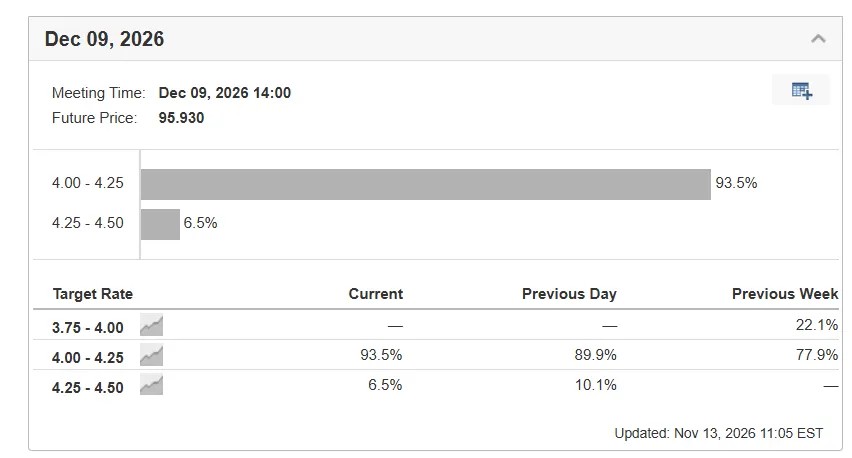
These figures replicate dealer expectations, not a choice by the Fed. The central financial institution’s present goal vary is 3.75% to 4.00%.
Friday’s producer-price report added to the issues. Wholesale costs rose 0.3% in October, lower than forecast, however elevated 6.5% 12 months over 12 months, the biggest annual bounce since 2022.
For Bitcoin, increased charges make conventional interest-bearing investments comparatively extra engaging, lowering the attraction of speculative belongings.
ETF withdrawals deepen promoting strain
In the meantime, U.S. spot Bitcoin ETFs have registered six consecutive periods of web outflows, totaling roughly $1.49 billion between November 5 and November 12.
Thursday’s $47.7 million withdrawal prolonged the five-day outflow streak, bringing one other supply of strain to an already struggling market.
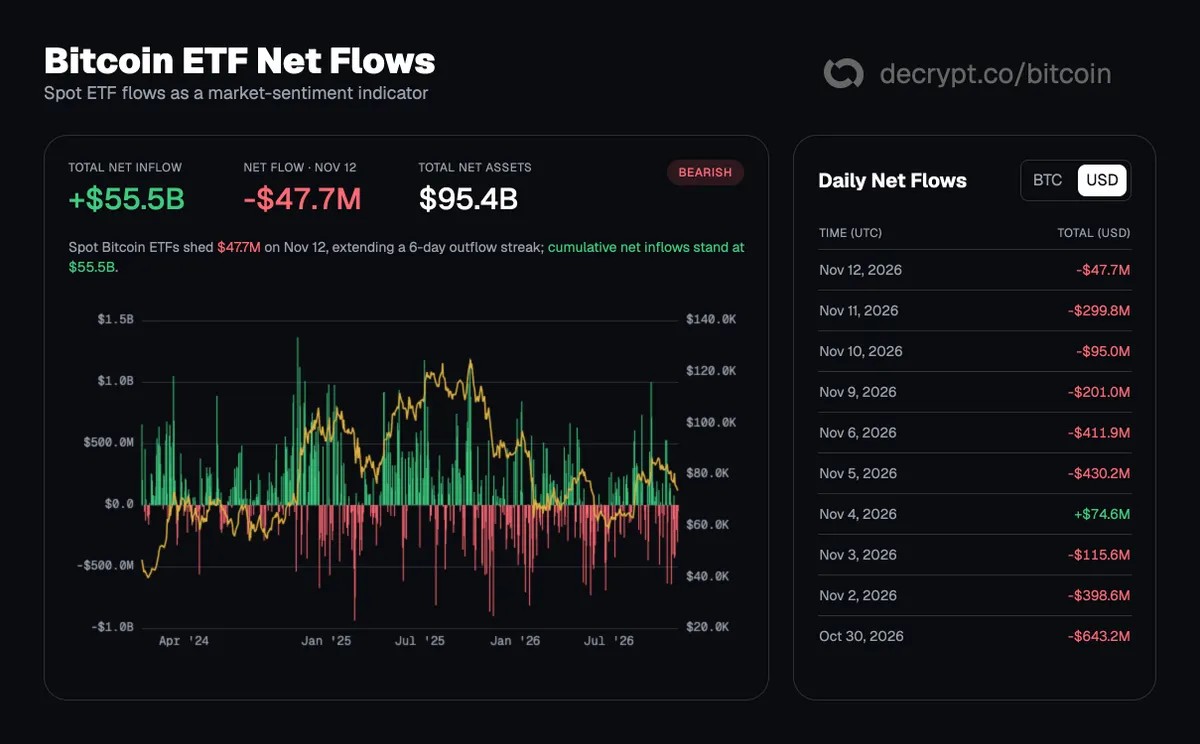
That doesn’t imply institutional buyers have deserted Bitcoin. The funds nonetheless maintain roughly $55.5 billion in cumulative web inflows, but it surely does present the state of nervousness that buyers are feeling.
Weakening ETF demand, mixed with compelled liquidations of leveraged merchants, can speed up a decline when patrons are scarce.
Bitcoin worth: What the technical indicators say
Bitcoin’s day by day chart now exhibits a transparent sequence of decrease highs and decrease lows, confirming a bearish short-term trajectory.
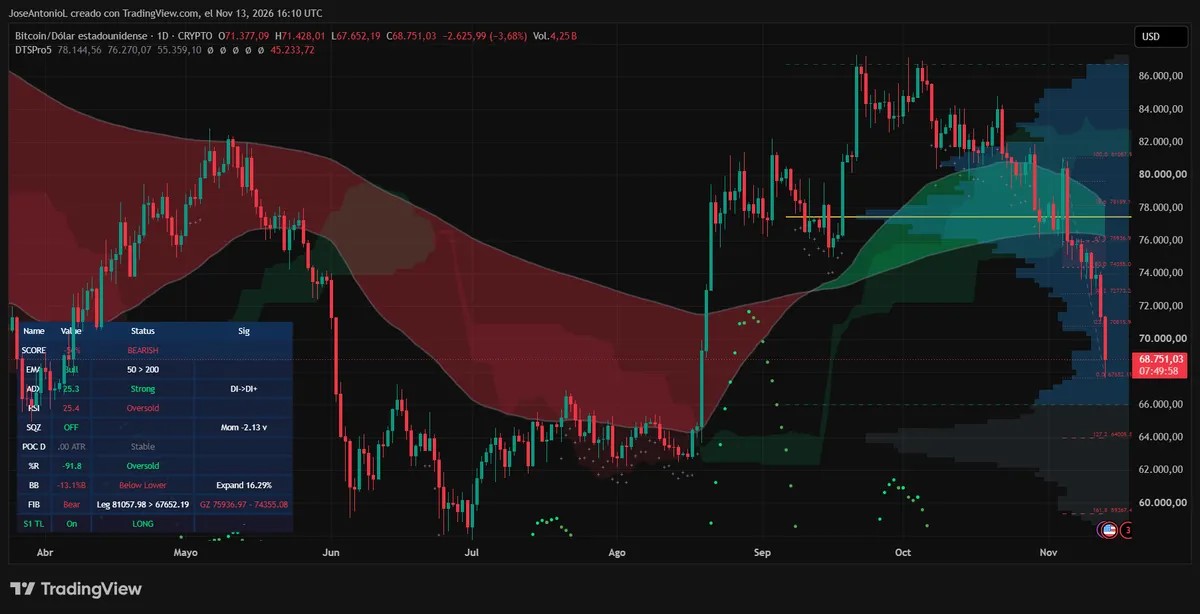
Its relative power index, or RSI, has dropped to 25.4. Readings beneath 30 are usually thought-about oversold, suggesting the promoting could also be stretched.The common directional index, or ADX, stands at 25.3, indicating a longtime pattern. Mixed with declining costs, that implies bearish momentum stays significant.
There may be nonetheless one longer-term constructive sign: the 50-day exponential transferring common stays above the 200-day EMA, preserving a bullish moving-average configuration. However Bitcoin’s worth has fallen beneath the shorter-term common, indicating that latest momentum has turned in opposition to patrons.
Speedy assist sits round $67,650, Friday’s intraday low. Shedding that degree may expose a deeper assist space close to $64,000.
On the upside, Bitcoin must get better $70,815 and $72,775 earlier than difficult the stronger resistance zone between $74,355 and $75,937.
The mix of maximum oversold readings and robust downward momentum leaves room for a brief bounce, however not sufficient proof to declare a backside.
For now, merchants face two main macroeconomic checkpoints: the Fed’s November 18 assembly minutes and the November 25 PCE inflation report, each of which may affect expectations forward of December’s interest-rate choice.