
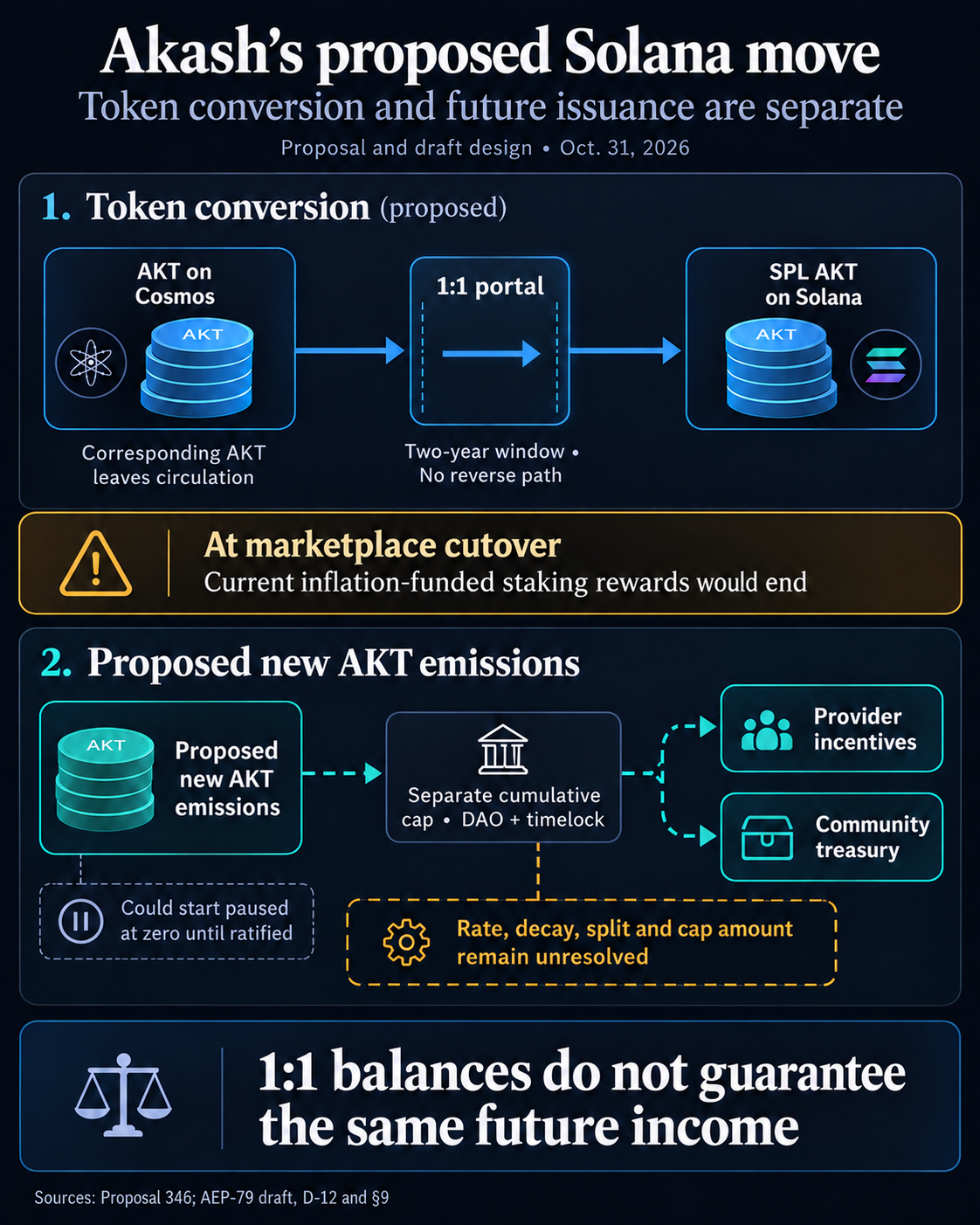
That distinction issues as a result of a promise to change one outdated $AKT for one SPL $AKT preserves a stability at conversion. It doesn’t, by itself, protect the revenue connected to holding or staking that stability.
Staking revenue and incentive emissions
The proposal separates approval, token launch, market cutover and the outdated chain’s eventual halt. Outdated-chain inflation and staking rewards would finish at cutover. Validator roles and revenue would finish at halt, 90 days later.
The submitted proposal expects SPL $AKT and the one-way portal to launch two to 3 weeks after passage, as soon as token and portal audits are full. {The marketplace} would transfer solely after its audits and migration rehearsals go and a separate cutover proposal is authorized.
The proposal now being voted on describes a portal transaction that begins unbonding, claims rewards and queues migration after 21 days. Earlier descriptions differ: the Oct. 20 technical draft makes use of seven days to token launch and 14 days for unbonding, whereas the Oct. 26 weblog says two weeks to launch and unbonding for 21 days earlier than utilizing the portal.
These descriptions don’t set up one settled person circulation. The present proposal units the authorization being voted on; remaining audited directions would nonetheless must reconcile the older draft and the weblog.
In his Oct. 26 clarification, Greg Osuri stated new staking mechanisms can be introduced earlier than cutover. That establishes a dedication to elucidate a alternative, fairly than a broadcast alternative yield or payout formulation.
Who might obtain new $AKT
Akash’s AEP-79 migration design makes a separate provision for alternative emissions: newly issued $AKT directed to supplier incentives and the group treasury. It describes decreased gross emissions because the meant route, however leaves the numerical curve for modeling and governance.
Below the proposed design, a holder might lose the current inflation-funded staking revenue whereas new tokens continued to be issued for different functions. Issuance to these accounts would increase the token base with out robotically rising a passive holder’s stability.
The unresolved financial modeling covers the gross charge, decay, break up between recipients and cumulative hard-cap quantity. These decide each how a lot new $AKT might enter provide and the way its distribution would change over time.
The token-migration draft specifies a cumulative incentive-emissions cap separate from the migration funds. Its numerical quantity stays unresolved; as soon as set from the ratified mannequin, the cap couldn’t be raised by governance. The schedule would stay adjustable by way of the DAO and a timelock inside that restrict, with a guardian in a position to pause emissions.
The draft additionally permits a paused begin. If the mannequin has not been ratified earlier than the cutover provide snapshot, the token-issuance program would begin with zero scheduled emissions and anticipate governance activation. That may be a contingency within the design, fairly than a choice to finish issuance completely.
These are proposed controls over a future program. They provide no remaining numerical ceiling, emission charge or date on which alternative incentives would start.
Compute credit and the availability query
Compute funds might additionally have an effect on how a lot $AKT stays out there to commerce. Their provide implications rely on the accounting mannequin, and the roadmap and proposed Solana design describe completely different limits.
Akash’s AEP-76 roadmap describes ACT as a nontransferable, dollar-denominated compute credit score. Its proposed burn-mint equilibrium (BME) mannequin hyperlinks funding these credit to $AKT faraway from liquid circulation.
The roadmap’s detailed vault mannequin makes use of beforehand eliminated $AKT and remint credit first. If these are inadequate to fulfill a payout, it describes minting a shortfall. That describes a doable issuance path inside the roadmap’s mannequin; compute utilization alone isn’t sufficient to ascertain a everlasting internet burn.
The proposed Solana structure specifies a distinct restrict: $AKT provided for ACT stays in a vault as collateral, and ACT redemption is paid from that vault. It expressly forbids the BME program from minting $AKT.
The doc additionally leaves current-chain vault payouts versus contemporary minting as an implementation query. The roadmap’s shortfall-minting description consequently doesn’t set up a fresh-minting path for the proposed Solana system.
The availability results must be separated: tokens represented by way of migration, new incentive emissions, and $AKT shifting into and out of compute-credit collateral. A vault stability briefly faraway from buying and selling isn’t the identical factor as tokens completely destroyed.
The proposed portal would stay open for 2 years, with migration irreversible. Its 1:1 accounting solutions how eligible token balances can be represented on Solana. The longer term emissions curve and alternative staking phrases reply completely different questions on holders’ revenue and publicity to issuance.
The proposal says the emissions curve have to be printed earlier than the later cutover proposal. Alongside the promised staking particulars and resolved compute-credit accounting, it could give holders the knowledge wanted to evaluate the post-migration mannequin.